

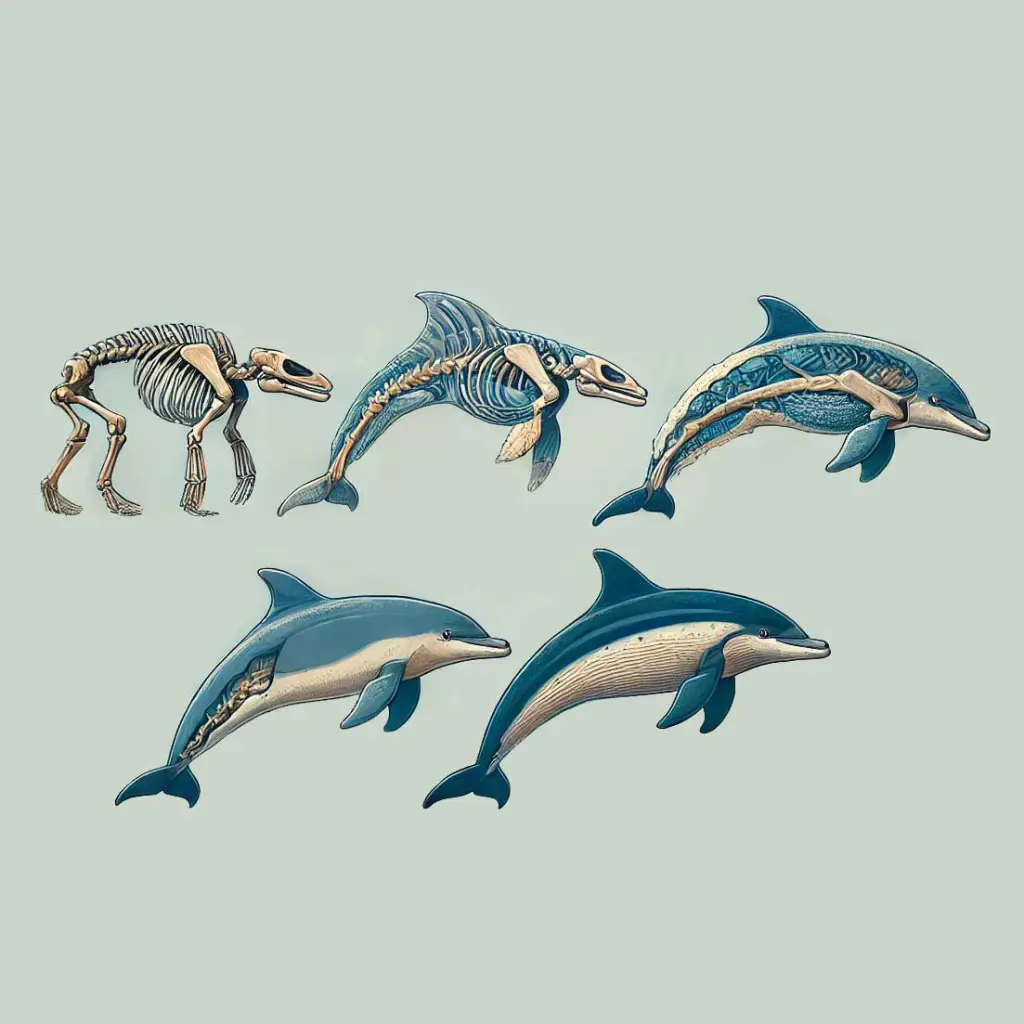
The spinner dolphins that gather off Oahu’s Waianae Coast each morning are the result of roughly 50 million years of continuous evolutionary change. Their ancestors walked on land. They had four legs, a full coat of fur, and breathed air the way any terrestrial mammal does. What happened between then and now is one of the most well-documented transformations in the fossil record, and the evidence for it is still visible in the bodies of every dolphin alive today.
Where dolphins came from: the land-dwelling ancestors
The fossil record tells a clear story. The earliest known ancestor of modern cetaceans, a group that includes dolphins, whales, and porpoises, was Pakicetus, a dog-sized mammal that lived approximately 50 million years ago in what is now Pakistan and India. Pakicetus was fully terrestrial: it walked on four legs, had hooves, and lived near rivers and shallow coastal waters where it likely waded and swam to catch fish.
Over the next 15 to 20 million years, descendants of Pakicetus gradually became more aquatic. Ambulocetus, another transitional fossil from roughly 48 million years ago, could walk on land but was also an efficient swimmer, propelling itself through water with an up-and-down spine motion similar to modern cetaceans. By around 35 million years ago, fully aquatic cetaceans had appeared, with front limbs modified into flippers and hind limbs beginning to reduce.
The evolutionary pressures driving this transition were straightforward. Access to food in shallow coastal and river environments was abundant. Animals better adapted to aquatic life survived and reproduced more successfully. Over millions of generations, traits that improved swimming performance were selected for, and traits associated with terrestrial life were gradually lost.
Why dolphins lost their hind limbs
The loss of hind limbs in cetaceans was not a single event but a gradual process spanning millions of years. In transitional species like Ambulocetus, hind limbs were present but reduced. In later species, they became vestigial, too small to be functional but still present as internal remnants. In modern dolphins, those remnants remain.
Today’s spinner dolphins carry small, internal pelvic bones that serve no locomotory function. These vestigial structures are direct physical evidence of the hind limbs their ancestors possessed. In rare cases, dolphins are born with small external projections near the tail region, an occasional reappearance of a trait that evolution has suppressed but not entirely erased from the genome.
The functional reason for losing hind limbs was straightforward. Large, protruding hind limbs created drag in the water, reducing swimming efficiency. Animals with smaller, less prominent hind limbs were faster and more maneuverable, which translated directly into better hunting performance and survival. Over millions of generations, the selection pressure was consistent: smaller hind limbs were better, and eventually no hind limbs at all were better still.
Body hair: the evolutionary trace still visible at birth
Adult dolphins appear hairless. Run your hand along the skin of a dolphin and you find smooth, almost frictionless surface with no visible hair. But dolphins are mammals, and like all mammals, they retain the genetic instructions for producing hair.
The evidence appears at birth. Newborn spinner dolphins, including the calves you can observe alongside their mothers on a Dolphins and You morning tour, are born with fine sensory hairs along the rostrum, the elongated snout. These hairs are not decorative remnants. In newborn dolphins, they appear to function as tactile sensors, helping the calf detect water movement and maintain proximity to its mother during the critical first days of life.
Within weeks of birth, these hairs are shed and do not regrow. The adult dolphin retains only the follicle structures in the skin, visible under microscopy but producing no visible hair. This brief window of visible hair in newborn calves is one of the clearest physical reminders that dolphins are descended from furry, land-dwelling mammals. The genetic instructions for hair production are still present in every dolphin’s DNA. They are simply suppressed after the first weeks of life.
Will dolphins ever evolve gills?
This is one of the most common questions about dolphin evolution, and the scientific answer is almost certainly no. Here is why.
Evolution does not work toward a goal. It operates through random genetic variation filtered by environmental selection pressures. For gills to evolve in dolphins, several conditions would need to be met simultaneously over an extremely long time period: random mutations would need to produce structures capable of extracting oxygen from water, those structures would need to provide a survival advantage significant enough to be consistently selected for, and the existing respiratory system would need to transition away from air breathing without killing the organism in the process.
None of these conditions exist. Dolphins are extraordinarily efficient air breathers. They exchange up to 80 percent of their lung capacity in a single breath, compared to roughly 15 percent for humans. They can hold their breath for extended periods and dive to significant depths. Their current respiratory system is not a limiting factor in their survival or reproductive success. There is no selection pressure driving the evolution of an alternative.
Additionally, gills are not simply an organ that can be added to an existing body plan. They require an entirely different circulatory architecture, different blood chemistry, and structural modifications throughout the head and neck. Evolving gills from scratch, in an animal whose ancestors discarded them hundreds of millions of years ago when early vertebrates first moved onto land, would require the kind of large-scale restructuring that evolution does not accomplish through small incremental steps.
Dolphins will remain air breathers for as long as the species exists.
What the evolutionary history reveals about dolphins today
Understanding where dolphins came from changes the way you see them in the water. The way spinner dolphins hunt, using coordinated group strategies and echolocation rather than gills or passive filter feeding, reflects 50 million years of selection for active, intelligent pursuit predation. Their ability to navigate complex social structures, maintain long-term relationships, and adapt behavior to changing conditions is the product of the same evolutionary pressures that shaped their bodies.
The vestigial pelvic bones, the brief coat of sensory hairs at birth, the conscious breathing that requires them to surface regularly, all of these are traces of the land-dwelling ancestors that started this journey. What you see on a morning tour off the Waianae Coast is the current chapter of a story that began on a riverbank 50 million years ago.
The intelligence that makes dolphins so remarkable today did not appear overnight. It is the accumulated result of millions of generations of selection for animals that could think, cooperate, and adapt faster than their prey and their environment could change.
Want to learn more about how Hawaii’s spinner dolphins are built to survive?
👉Return to the Spinner Dolphin Anatomy and Biology guide →
Tours depart from Waianae Boat Harbor, West Oahu, where Hawaii’s spinner dolphins gather every morning.