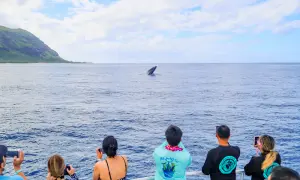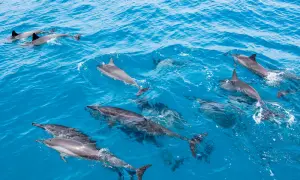



The spinner dolphins you see off the Waianae Coast during the morning are resting. They are slow-moving, socializing near the surface, and taking their time. But the night before, they were doing something completely different.
They were out in open water doing what spinner dolphins do at night, hundreds of them, working together to track down and catch prey in near-total darkness hundreds of feet below the surface.
The spinner dolphins you see off the Waianae Coast during the morning are resting. They are slow-moving, socializing near the surface, and taking their time. But the night before, they were doing something completely different.
They were out in open water doing what spinner dolphins do at night, hundreds of them, working together to track down and catch prey in near-total darkness hundreds of feet below the surface.
Understanding what dolphins eat and how they hunt changes the way you look at them entirely.
What do spinner dolphins eat?
Spinner dolphins are carnivores. Their diet consists almost entirely of other animals, and in Hawaiian waters that means three main prey types.
Small mesopelagic fish make up the largest portion of their diet. These are species that spend their days in the deep ocean, between roughly 200 and 1,000 meters below the surface, and rise toward shallower water each night to feed. Lanternfish are a common example, small, bioluminescent fish that exist in enormous numbers in the deep ocean around Hawaii.
Squid are a reliable and energy-dense food source. Hawaiian waters support a wide variety of squid species, and spinner dolphins are skilled at catching them even when squid are moving quickly and changing direction.
Shrimp and small crustaceans round out the diet, particularly during nights when the mesopelagic layer is densely packed with invertebrates migrating upward.
A healthy adult spinner dolphin needs roughly 15 to 20 pounds of food per night to maintain its energy. Dolphins do not chew their prey. They use their cone-shaped teeth purely for gripping slippery animals and swallow everything whole. A spinner dolphin carries between 180 and 250 teeth arranged in four rows, one of the highest tooth counts of any dolphin species, precisely because catching fast-moving prey at depth requires a firm, reliable grip.
Dolphins also get most of their fresh water from their food. Fish and squid contain roughly 70 percent water by weight, which means a good night of hunting keeps a dolphin hydrated as well as fed.
Where does the hunting happen?
The answer is deeper than most people expect.
Hawaii’s islands rise steeply from the seafloor, which means deep water is accessible within a short swim from the coast. Every night, billions of small fish, squid, and crustaceans migrate upward from the deep ocean toward the surface in what scientists call the deep scattering layer, one of the largest daily migrations of animals on the planet.
Spinner dolphins follow this migration. As the sun goes down, pods that spent the day resting in shallow coastal bays move offshore into open water. By midnight, they may be hunting at depths of 200 to 500 meters, in near-total darkness and cold water far from shore.
This is why the dolphins you see on a morning tour are calm and slow-moving. They finished hunting hours before sunrise and have been traveling back toward the coast ever since.
How spinner dolphins hunt as a team
Spinner dolphins are not solitary hunters. The strategies they use to catch prey depend on coordination between many animals working together, and those strategies are more sophisticated than most people realize.
Echolocation as a targeting system
Before a dolphin can catch anything, it has to find it. In the darkness of the deep ocean, vision is nearly useless. Spinner dolphins rely on echolocation, emitting rapid bursts of clicks that travel through the water, bounce off prey, and return as echoes. By analyzing those echoes, a dolphin can determine the size, location, and movement direction of a fish or squid with remarkable precision, even at significant distances.
Herding and corralling
Once a school of fish is located, the pod works together to concentrate them. Groups of dolphins spread out and swim around the edges of a school, gradually tightening the circle. As the fish school compresses into a dense ball near the surface, individual dolphins take turns driving through the center to feed. This technique, sometimes called a bait ball, is one of the most effective group hunting strategies in the ocean.
Deep dives and vertical feeding
Not all prey is found in a tight school. Spinner dolphins also make repeated deep dives to intercept individual fish and squid migrating through the water column. These dives require sustained breath-holding and the ability to navigate effectively in darkness, both of which spinner dolphins have developed over millions of years of evolution.
The role of spinning in the hunt
The signature spinning behavior that gives spinner dolphins their name is most often associated with play and social signaling. But researchers have observed an increase in spinning activity during the transition from rest to hunting, and during active feeding events near the surface.
One leading hypothesis is that the loud splash a spinning dolphin creates when it re-enters the water serves as a coordination signal, a way to communicate location and activity to other members of the pod during a chaotic feeding event. Whether the primary function is communication, parasite removal, or something else entirely, the connection between spinning and active hunting behavior is consistent enough to be worth noting.
From the hunt to your morning tour
The daily rhythm of Hawaiian spinner dolphins is built entirely around the hunt.
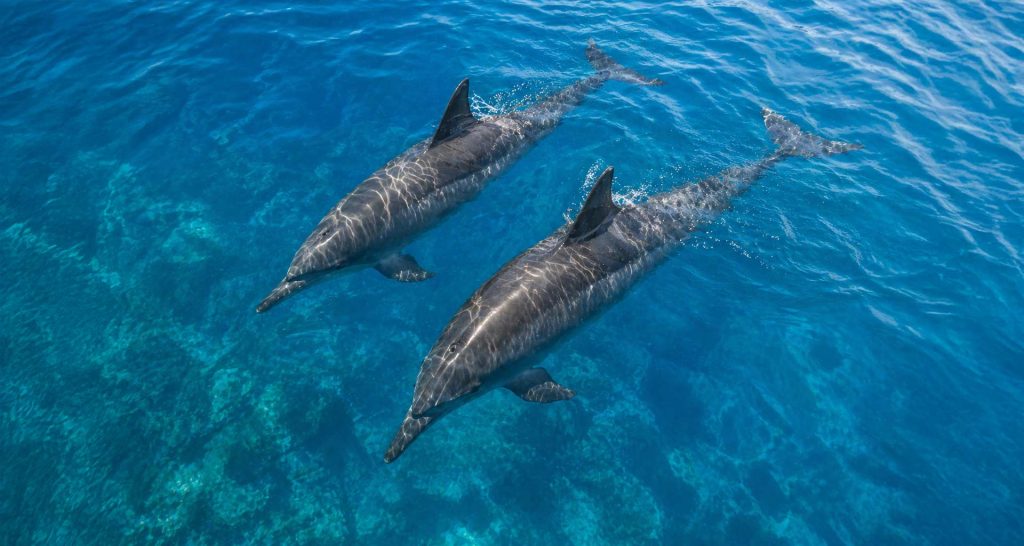
They rest during daylight hours in the protected, shallow bays of West Oahu, including the Waianae Coast, where Dolphins and You tours operate. As evening approaches, they move offshore. By night, they are hundreds of meters below the surface, working as a coordinated group to catch enough food to sustain the entire pod. Before sunrise, they return to the coast to begin the rest cycle again.
This predictability is one reason the Waianae Coast is one of the best places in the world to observe wild dolphins. The morning gathering is not random. It is the endpoint of a nightly routine that has remained consistent in Hawaiian waters for thousands of years. To see how this fits into the full 24-hour cycle of spinner dolphin life, read our complete daily routine guide →
When you watch a pod drifting slowly near the surface in the morning, you are watching animals in recovery after hours of deep-water hunting. The calm you see is earned.
Want to go deeper on how Hawaii’s spinner dolphins behave and survive?
👉Return to the Dolphin Behavior and Intelligence guide →

Tours depart from Waianae Boat Harbor, West Oahu, where spinner dolphins gather every morning after a full night of hunting.