


Dolphins are widely described as intelligent. But that word gets applied to a lot of animals, and it rarely comes with much explanation. What does dolphin intelligence actually consist of? What can they do that most animals cannot, and how do we know?
The answers are more specific and more surprising than the general reputation suggests.
Brain size is the starting point, but not the whole story
One of the first things scientists look at when comparing animal intelligence is the encephalization quotient, or EQ. This is a measurement of brain size relative to body size, and it gives researchers a rough baseline for comparing cognitive potential across species.
By this measure, dolphins rank second among all animals on Earth. Only humans score higher. A dolphin’s EQ exceeds that of chimpanzees, gorillas, and every other non-human primate.
But brain size alone does not tell you much. What matters is what the brain is doing. Dolphin brains have a highly developed neocortex, the region associated with complex thinking, social behavior, and emotional processing in mammals. The folding of the dolphin neocortex, which increases surface area and therefore processing capacity, is in some respects more elaborate than our own.
When researchers estimate dolphin cognitive ability in developmental terms, they often compare it to a human child of around three to five years old. That is a rough comparison and an imperfect one, but it gives a sense of the scale involved.
Memory: the longest social recall in the animal kingdom
One of the most well-documented aspects of dolphin intelligence is their memory, particularly their social memory.
Every dolphin develops a unique signature whistle within the first few months of life. This whistle functions as an individual identifier, something close to a name. Dolphins use these signature whistles to call to specific individuals and to announce their own presence within a group.
What makes this remarkable is how long those memories last. A study published in 2013 tested whether bottlenose dolphins could recognize the signature whistles of former tank-mates they had not heard in over 20 years. They could. Not only did the dolphins recognize the whistles, but they also responded with clear signs of recognition and interest.
Twenty years is the longest social memory ever recorded in a non-human species. It exceeds the social recall of elephants, which were previously thought to hold the record.
This memory is not limited to sound. Dolphins also recognize individuals by movement patterns in the water, and in controlled studies, trained dolphins have shown the ability to distinguish between multiple human handlers and respond to specific cues from each one. Some wild dolphins have been documented repeatedly approaching specific divers over time, which suggests that recognition and memory extend into the open ocean as well.
Dolphin memory is also highly associative. Rather than storing isolated facts, dolphins appear to link information together into something closer to a mental map. They remember where food sources were found during previous seasons, where specific individuals were last encountered, and which locations carry risk. This kind of relational memory is what allows them to navigate and make decisions in a complex, constantly changing environment.
Self-awareness: passing the mirror test
The test is simple: place a mark on an animal’s body where they cannot see it directly, then show them a mirror. If the animal uses the mirror to investigate the mark, it suggests they understand that the reflection is of themselves rather than another individual.
Very few species pass this test. The confirmed list includes humans, great apes, elephants, certain corvids, and dolphins.
In one well-known study, a dolphin named Presley noticed a mark on his body while looking in a mirror and turned to investigate it directly, showing a clear understanding that the reflection was his own image. This is not a behavior that can be trained into an animal. It requires a pre-existing concept of self.
Self-awareness of this kind has significant implications. It suggests that dolphins have an internal model of themselves as distinct individuals, which is a prerequisite for many of the more complex social behaviors they display, including empathy, cooperation, and the kind of long-term relationship management that defines dolphin social life.
Problem solving and tool use
Intelligence in the wild is often best measured by what an animal does when it faces a new problem, and dolphins are consistent innovators.
Tool use was long considered a defining marker of human intelligence. Then researchers began documenting dolphins in Shark Bay, Australia, carrying marine sponges on their snouts while foraging along the seafloor. The sponges protect the dolphins’ sensitive rostrums from abrasion while they dig for prey. This behavior is passed down from mothers to daughters across generations, which means it is not an individual innovation but a form of cultural transmission, one of the markers of genuine learning communities.
In controlled laboratory settings, dolphins have solved multi-step puzzles, learned to follow instructions delivered through a symbolic language board including hundreds of distinct symbols, and demonstrated an understanding of syntax, meaning they can respond differently to the same words arranged in different orders. That sensitivity to word order is a prerequisite for understanding language, and it is extremely rare outside of humans and other great apes.
Dolphins have also been observed teaching each other. When one dolphin in a study group learned a new technique for obtaining food, others in the group learned the same technique by watching, without being trained directly.
Emotional intelligence and social complexity
Perhaps the most striking dimension of dolphin intelligence is not cognitive but emotional.
Dolphins communicate through a layered system of clicks, whistles, and body language that allows them to coordinate complex group behavior, maintain long-term social bonds, and respond to the emotional states of individuals around them. They have been documented staying with injured companions, assisting other animals in distress, and, in multiple verified cases, placing themselves between sharks and human swimmers.
Dolphins also appear to grieve. There are documented cases of dolphins remaining with deceased companions for extended periods, behavior that most researchers interpret as an expression of loss rather than simple confusion. Grieving requires the recognition that a specific individual is gone, which in turn requires memory of that individual as a distinct social partner.
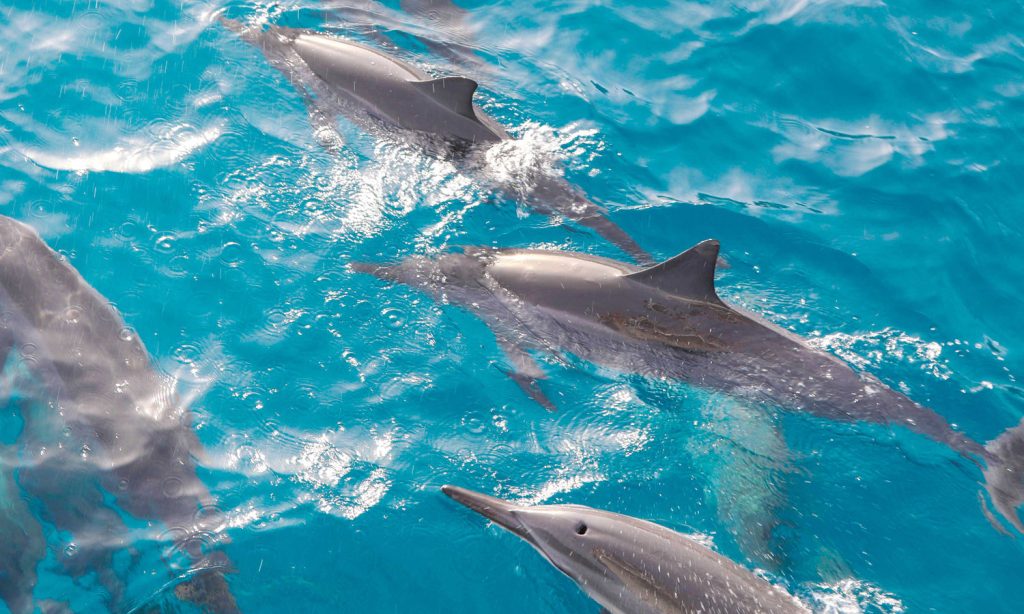
When you watch a pod of spinner dolphins from the boat off the Waianae Coast, the surface behavior, the slow circling, the synchronized breathing, the occasional physical contact between individuals, reflects a social world of considerable depth. These animals know each other. They track each other across time and distance. The relationships you are observing may have been maintained for years.
What this looks like on a morning tour
The spinner dolphins that gather along West Oahu every morning are not simply resting after a night of hunting. They are also doing something more complex: maintaining the social structure that makes their survival possible.
The alliances, the individual recognitions, the ongoing communication- all of this continues through the rest period. Dolphins that have hunted together, traveled together, and known each other for years are reinforcing those bonds during the same hours you are watching them from the water.
Understanding what is happening beneath the surface changes the experience entirely.
Join Dolphins and You on the Waianae Coast and spend a morning with some of the most cognitively sophisticated animals on Earth, in the wild, in their own habitat, on their own schedule.
If we’re stacking up the smartest non-human animals, here’s a solid top five list based on problem-solving, communication, memory, and self-awareness:
Want to explore more about how Hawaii’s spinner dolphins think and behave?
👉Return to the Dolphin Behavior and Intelligence guide →
Tours depart from the Waianae Coast, West Oahu, where Hawaii’s spinner dolphins gather every morning.