


Every dolphin has a name. Not in the way humans assign names from the outside, but in a way that may be even more remarkable: each dolphin creates its own unique identifier in the first months of life, and other members of its pod learn that sound and use it to call that specific individual for the rest of their lives.
Scientists call these sounds signature whistles, and the research on them is among the most compelling evidence of the depth of dolphin social intelligence.
What a signature whistle actually is
A signature whistle is a distinctive pattern of frequency modulations, the rise and fall of a whistle’s pitch over time, that is unique to a single dolphin. Unlike most animal vocalizations, which are shared across a population, signature whistles are individually unique in the same way that human voices and faces are unique.
Dolphins produce these whistles through structures near their blowholes rather than through a larynx, which means they can vocalize underwater without losing air. The acoustic signature of each whistle is stable enough that researchers can identify individual dolphins from recordings alone, and distinctive enough that other dolphins in the same pod recognize specific whistles as belonging to specific individuals.
This is not a system shared equally by all dolphin species. It is particularly well-developed in bottlenose dolphins and spinner dolphins, species that live in complex, fluid social groups where individual recognition matters enormously.
How dolphins develop and use their whistles
Dolphins begin developing their signature whistles in the first few months of life. The process appears to involve a period of vocal experimentation similar to the babbling phase in human infants, during which the dolphin produces a variety of sounds before settling on a stable pattern.
Once established, the signature whistle changes very little over a dolphin’s lifetime. Researchers who have tracked individual dolphins across decades have found that the same whistle pattern that identified an animal as a calf is still recognizable in the same animal as an adult twenty years later.
Mother dolphins adjust their whistle behavior around their newborn calves in ways that appear to support early vocal learning. Some research suggests that mothers produce their own signature whistles more frequently in the days immediately after birth, possibly to help the calf imprint on the sound before the calf begins developing its own.
Dolphins use signature whistles in several distinct ways. They produce their own whistle to announce their presence and location within a group. They copy and produce the whistles of other dolphins to call or address specific individuals. And they use whistles to maintain contact with companions when visibility is limited or when a group is spread across a large area of water.
The 20-year memory: what makes this remarkable
In 2013, researchers published a study testing whether dolphins could recognize the signature whistles of former companions they had not encountered in over 20 years. The dolphins could. Not only did they recognize the whistles, but they responded with clear signs of recognition and social interest.
Twenty years is the longest social memory documented in any non-human species. It exceeds the social recall of elephants, which had previously held the record. For context, a spinner dolphin that lives to 25 years old and recognizes a companion’s whistle after a 20-year separation is demonstrating a social memory that spans most of its life.
This kind of long-term social memory is one of the defining features of dolphin intelligence and reflects the complexity of the social world they need to track. A dolphin that lives in a fission-fusion society, where the composition of the group shifts daily, needs to maintain a detailed mental record of who individuals are, what their relationships are, and where they fit in the social hierarchy. Signature whistles are the acoustic tool that makes this possible.
How dolphins recognize and call each other by name
The copying behavior that allows dolphins to call each other by whistle is one of the most sophisticated vocal behaviors documented in any non-human animal.
When one dolphin produces the signature whistle of another specific dolphin, that animal responds preferentially, at higher rates than it responds to unfamiliar whistles or to the signature whistles of other pod members. This is the functional equivalent of calling someone by name and having them turn around, using a sound that both parties recognize as belonging to that specific individual.
This behavior has been documented in both captive and wild populations. In wild spinner dolphins, whistle exchanges happen continuously during the morning rest period as animals maintain contact across the pod and reinforce the social bonds that hold the group together.
What this looks like in a spinner dolphin pod
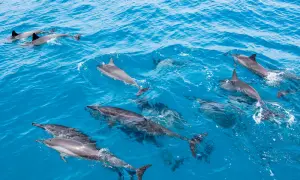
Spinner dolphin pods operate through a continuous exchange of acoustic information. The signature whistles, the echolocation clicks, the burst-pulse sounds of social interaction- all of this is happening simultaneously beneath the surface of what looks, from a boat, like a quietly resting group of animals.
When you watch a pod at the surface, you are seeing the visible layer of a much more active social world. The slow movements, the occasional brief contact between animals, the synchronized breathing, are all accompanied by a constant acoustic conversation that reinforces individual identities and social bonds in real time.
The morning rest period that spinner dolphins spend in the shallow coastal waters of the Waianae Coast is not a period of silence. Even during their half-brain sleep, dolphins continue to produce and respond to sounds, keeping the social fabric of the pod intact through the rest period.
Why this matters when you are on the water
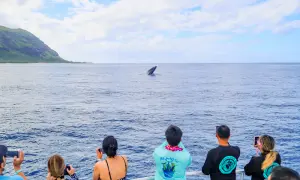
When a spinner dolphin approaches the bow of the boat off the Waianae Coast and another dolphin in the pod produces a specific whistle in response, you are hearing something that has a direct parallel in human social life. One animal is calling another by name. The called animal knows its own name. And both animals have been using this system with the same individuals, in some cases, for longer than most human friendships last.
Join us on the Waianae Coast and watch a community of animals that know each other in ways that most visitors never consider.
Want to explore more about how Hawaii’s spinner dolphins think and communicate?
👉Return to the Dolphin Behavior and Intelligence guide →
Tours depart from Waianae Boat Harbor, West Oahu, where Hawaii’s spinner dolphins gather every morning.