


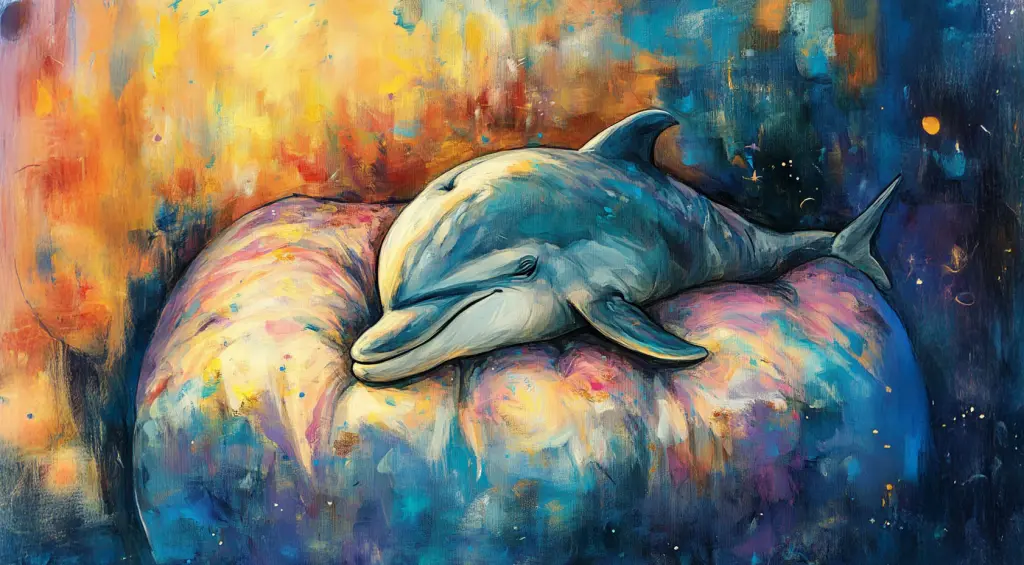
Yes, dolphins sleep. But not like you do.
If you’ve ever watched spinner dolphins drifting slowly near the surface off Oahu’s Waianae Coast, barely reacting to the boat, eyes half-open, moving in slow circles, you were watching a dolphin asleep. It just doesn’t look anything like sleep as we know it.
Here’s why, and what’s actually happening inside that brain.
Dolphins are conscious breathers, and that changes everything
Humans breathe automatically. When you fall into a deep sleep, your body keeps breathing without any input from your conscious mind.
Dolphins can’t do that.
Dolphins are what scientists call conscious breathers, meaning they have to actively decide to surface and take a breath, even while resting. If a dolphin fully lost consciousness the way we do during sleep, it would stop breathing. It would sink. It would become easy prey.
So over millions of years, dolphins evolved a completely different solution.
Half the brain sleeps. The other half stays on
Half the brain sleeps. The other half stays on.
The technical term is unihemispheric slow-wave sleep (USWS), and it’s one of the most remarkable adaptations in the animal kingdom.
Here’s how it works:
- One hemisphere of the brain enters a restful, low-activity state, which is genuine sleep
- The other hemisphere stays active, monitoring breathing, watching for danger, keeping the dolphin moving
- One eye closes, connected to the resting half of the brain
- The other eye stays open, connected to the active half
After a period of time, the dolphin switches sides. The resting half wakes up, the active half gets its turn to rest, and the open and closed eyes swap.
The result: the dolphin gets real, restorative sleep while never fully going offline. It is survival sleep, perfectly engineered for life at sea.

What does a sleeping dolphin actually look like?
If you know what to watch for, you can spot it from the boat.
Sleeping spinner dolphins typically:
- Swim very slowly – barely moving, just enough to stay near the surface
- Circle in tight groups – staying close to their pod for safety
- Surface rhythmically – rising to breathe, then sinking gently, over and over
- Barely react to nearby boats or sounds
This resting behavior is one of the main reasons NOAA regulations require boats to stay at least 50 yards from spinner dolphins in Hawaiian waters. The dolphins aren’t being lazy. They are resting after a full night of deep-water hunting — and disturbing that rest has real consequences for their health and survival.
When do dolphins sleep?
Hawaiian spinner dolphins follow a daily rhythm almost opposite to ours.
At night, they head offshore into deep, dark water, sometimes diving hundreds of meters, to hunt squid and fish that migrate toward the surface after dark. It’s demanding, coordinated work that can last most of the night.
During the day, they return to the calmer, shallower bays of West Oahu, the same bays where Dolphins and You tours operate, to rest, socialize, and recover.
On average, dolphins sleep in short bursts totaling roughly 4 to 8 hours across a 24-hour cycle. Never all at once. Never fully unconscious. Always ready to surface, respond, and move.
Can dolphins sleep underwater?
Yes, for brief periods, but it’s more of a drift than a deep sleep.
Some dolphins practice a behavior called logging, where they float motionless at or just below the surface, eyes closed (or one eye closed), rising slowly to breathe without fully waking. It looks like a log floating in the water, which is how it got its name.
Because they still need to breathe air, dolphins can never sleep fully submerged for long. Their sleep is designed around the surface, not away from it.
Do dolphins dream?
We don’t know for certain, but the science hints at the possibility.
Dolphins have been observed in what appears to be REM-like sleep states, with twitching and small movements similar to what humans experience during dreaming. Whether those movements reflect a dream-like experience remains an open question. Given everything else we know about dolphin intelligence, including their self-recognition, their long-term memory, and their complex social bonds, it wouldn’t be surprising.
Dolphins as guardians: the Hawaiian perspective
In Hawaiian culture, spinner dolphins have long been seen as protectors and guides, nā koholā, believed to watch over sailors and fishermen at sea. That cultural significance adds another layer to what you are watching when a pod drifts slowly past the boat in the morning light. These animals are not just resting. In the Hawaiian tradition, they are keeping watch.
👉Explore the Hawaiian legends and cultural history of dolphins in Oahu →
Why this matters when you’re on the water
When you’re out with Dolphins and You along the Waianae Coast, the dolphins you see in the morning are almost certainly in various stages of their rest cycle. Some will be more alert, socializing or playing near the bow. Others will be logging near the surface, barely moving, caught in the middle of a sleep period.
Understanding this changes how you watch them.
These aren’t animals drifting through an easy paradise morning. They’re elite predators in recovery, resting between one night’s hunt and the next. The calm you see on the surface is the hard-earned quiet of animals doing exactly what their biology requires.
Watching them rest, with one eye open and half a brain still running, is one of the stranger and more beautiful things the ocean has to offer.
Want to explore more about how Hawaii’s spinner dolphins think and behave?
👉Return to the Dolphin Behavior and Intelligence guide →
Tours depart from the Waianae Coast, West Oahu, where wild spinner dolphins rest every morning.