



Do Dolphins Use Tools? Inside One of Science’s Most Surprising Discoveries
For most of human history, tool use was considered one of the things that set people apart from the rest of the animal kingdom. That idea started to unravel when researchers documented chimpanzees stripping leaves from twigs to fish termites from mounds, and it kept unraveling from there. Crows, elephants, and sea otters all joined the list of tool-using animals over the following decades. Now we know that wild bottlenose dolphins, Tursiops truncatus, have been using tools in the ocean for reasons that scientists are still working to fully understand. What they have found so far is remarkable, and a 2025 study just revealed that the behavior is even more cognitively impressive than anyone initially realized.
What It Actually Means for an Animal to Use a Tool
Scientists define tool use in animals fairly precisely: it involves picking up and manipulating an external object to accomplish a task that would be harder or impossible without it. Picking up a rock to throw at something counts. Using a stick to probe a hole counts. Simply pushing an object out of the way does not. By that definition, dolphins using sponges or shells to hunt qualify as genuine tool use, and that places them in very select company in the animal world.
What makes dolphin tool use particularly interesting is where it happens: underwater, in a three-dimensional environment, while managing the physical demands of breathing, swimming, and hunting simultaneously. Land animals that use tools can set things down, use their hands, and work slowly. Dolphins are doing something much harder while holding their breath.
The Spongers of Shark Bay
The most thoroughly documented example of dolphin tool use takes place in Shark Bay, a remote marine protected area on the western coast of Australia. Researchers first formally documented the behavior in 1997, though it had likely been happening for generations before anyone was watching with scientific eyes. A group of bottlenose dolphins in the bay had developed the habit of carrying cone-shaped marine sponges on their rostrums, the elongated snout and beak at the front of a dolphin’s face, while foraging along the sandy and rocky seafloor.
The sponge functions as a protective glove. Shark Bay’s seafloor in certain areas is covered with sharp rocks, coral rubble, and stinging creatures that would normally injure a dolphin pressing its snout into the sediment searching for buried fish. The sponge creates a physical barrier, allowing the dolphin to root around in places other dolphins leave alone entirely. The fish hiding in those areas are not just hidden by the environment. They are fish that lack swim bladders, the gas-filled organ that most fish use to control their buoyancy. That matters because dolphins typically detect fish using echolocation, and swim-bladder-less fish are nearly invisible to sonar. The spongers have found a way to access a food source that the rest of the dolphin population cannot.

A 2025 Discovery That Made Sponging Even More Impressive
For years, researchers understood that sponging was a clever workaround for hunting in difficult terrain. A 2025 study added a new layer to that picture. Scientists used a modeling technique to simulate how a sea sponge sitting on a dolphin’s rostrum affects the animal’s echolocation. What they found was that the sponge significantly distorts the acoustic signals the dolphin emits and receives, essentially scrambling the animal’s primary hunting sense while it forages.
That means sponging dolphins are not just doing something clever. They are doing something cognitively demanding. Every dive to the seafloor with a sponge requires the dolphin to compensate for distorted sensory feedback, adjust its interpretation of the signals it receives, and still manage to locate and catch prey. The researchers concluded that this helps explain one of the behavior’s most puzzling features: even though sponging dolphins catch better-quality fish in areas other dolphins cannot access, the behavior has not spread rapidly through the whole population. It is genuinely hard to master, and learning it requires close, patient guidance over a long period of time.
Shelling: An Even More Unusual Behavior
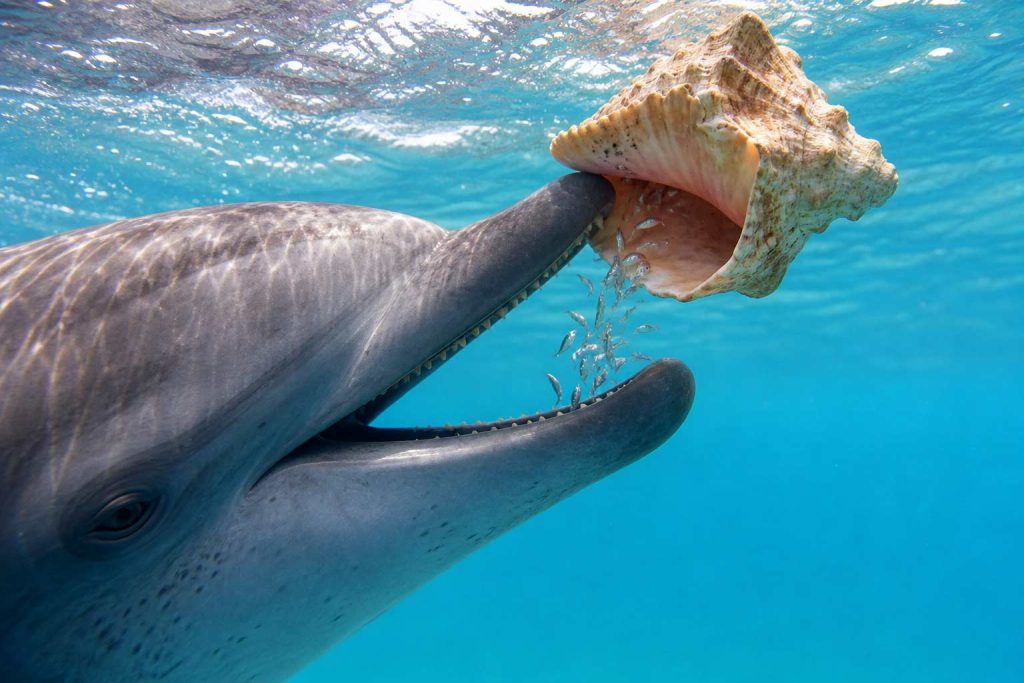
In 2011, researchers at Shark Bay documented a second tool-use behavior that had gone unrecorded until a dolphin was caught on camera doing something no one had expected. A bottlenose dolphin had trapped a fish inside a large cone-shaped sea snail shell that had been sitting on the seafloor. The dolphin picked up the shell, swam to the surface, and tipped it nose-down, shaking the fish out of the opening directly into its mouth.
This behavior, now called shelling, requires the dolphin to plan several steps ahead: locate a fish sheltering inside a shell, trap it there, carry the shell upward while the fish tries to escape, and then execute the tipping maneuver at precisely the right moment. It is a sequence of actions that demands patience, spatial reasoning, and an understanding of cause and effect. Shelling has since been documented in multiple individuals at Shark Bay, and like sponging, it appears to be spreading slowly through the population as other dolphins learn by watching.
Mud Ring Fishing: Teamwork as a Tool
Off the coast of Florida, in Sarasota Bay, researchers have documented a different kind of tool use that involves the environment itself rather than a physical object. A group of bottlenose dolphins has learned to work together to drive fish into shallow water, where one dolphin uses its powerful tail flukes to stir up a circular ring of sediment from the seafloor. The ring rises through the water as a curtain of cloudy mud, and the fish inside it, panicked by the enclosure, jump over what they perceive as a barrier. As they clear the surface of the water, the other dolphins waiting just outside the ring catch them mid-air.
This behavior requires precise coordination. The dolphin creating the mud ring has to execute the technique correctly, and the rest of the group has to be in position at exactly the right moment. Individual dolphins appear to specialize in specific roles within the hunt, with some consistently acting as the ring-maker while others focus on catching. That division of labor is rare in the animal world and suggests a level of social coordination that goes well beyond instinct.
How These Behaviors Are Passed Down
What makes all of these behaviors genuinely extraordinary is how they spread. They are not genetic. A dolphin is not born knowing how to use a sponge any more than a human child is born knowing how to ride a bicycle. The behaviors are learned, and almost exclusively from mothers. Research at Shark Bay has shown that calves born to sponging females spend years at their mother’s side watching and practicing the technique before they can do it reliably on their own. That is cultural transmission: the passing of a learned behavior from one generation to the next through observation and practice rather than through genes.
Interestingly, the sponging behavior at Shark Bay is almost exclusively practiced by females, even when male calves are raised by sponging mothers. Researchers believe this has to do with the different social demands on male and female dolphins. Males spend more of their time maintaining alliances with other males, which requires a different time investment. Females who sponge tend to forage alone in the rocky channel areas where the technique works, which suits their more solitary foraging style. The behavior is a perfect fit for females and a poor fit for the social life of males.
That is genuine culture operating at the species level: a behavior with clear benefits that has evolved socially within a community, is taught rather than inherited, and is shaped by the unique pressures and social structures of dolphin life.
What This Tells Us About Dolphin Minds
The cumulative weight of the sponging, shelling, and mud ring evidence tells us something important about how dolphin brains work. These are not reflexive behaviors. They require planning, patience, learning from observation, and the ability to use an object for a purpose other than the one it serves in nature. That is what researchers call secondary tool use, and in the animal kingdom it is extraordinarily rare.
Dolphins also pass these behaviors laterally between individuals, not just from mothers to calves. Researchers have documented shelling spreading to dolphins whose mothers did not practice it, suggesting that social learning in dolphin populations operates across multiple channels. An adult dolphin can observe a behavior in another adult, recognize its value, and add it to its own repertoire. That kind of flexible, socially driven learning is one of the hallmarks of high animal intelligence.
Dolphins in Hawaii: Intelligence You Can Witness
Hawaiian spinner dolphins have not been documented using physical tools the way Shark Bay’s bottlenose dolphins do, but they are no less impressive for it. Spinner dolphins in Oahu’s waters demonstrate remarkable coordinated hunting behavior, working together in synchronized groups to herd fish with precision that rivals the complexity of the mud ring technique. They use sound, movement, and apparent communication to maneuver prey in ways that benefit the whole group rather than just the individual. That is a different expression of the same underlying intelligence.
On our Dolphins and You tours off Oahu’s Waianae Coast, guests often get to see spinner dolphins in their natural environment during the morning rest and travel period, and the behavior visible from the boat, including how individuals coordinate movements, how calves stay close to their mothers, and how the pod responds to the presence of the boat as a unit, reflects the same kind of social intelligence that makes the sponging discoveries so compelling. These are not simple animals following simple patterns. They are adaptable, social, and capable of solutions that continue to surprise the scientists studying them.
The Ocean’s Most Resourceful Minds
The story of dolphin tool use is still being written. Researchers are currently studying whether sponging behaviors are emerging in other populations around the world, and whether shelling will continue to spread through the Shark Bay community as older non-shelling dolphins age out and younger, more curious individuals come of age. Every new season of fieldwork tends to add another piece to a picture that keeps getting more complicated in the best possible way.
What we know now is that dolphins are not just intelligent in the sense of being trainable or sociable. They are intelligent in the deeper sense of being capable of inventing solutions, refining them over time, and passing them to the next generation. That kind of intelligence does not stop at the water’s edge. It shows up in every pod of spinner dolphins making their morning run along the Waianae Coast, and in every encounter between a wild dolphin and the people lucky enough to be watching from the right boat at the right moment.
Want to explore more about how Hawaii’s spinner dolphins think and behave?
👉Return to the Dolphin Behavior and Intelligence guide →
Tours depart from Waianae Boat Harbor, West Oahu, where Hawaii’s spinner dolphins gather every morning.