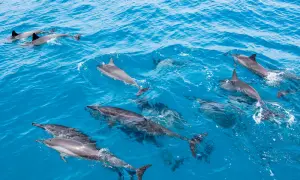


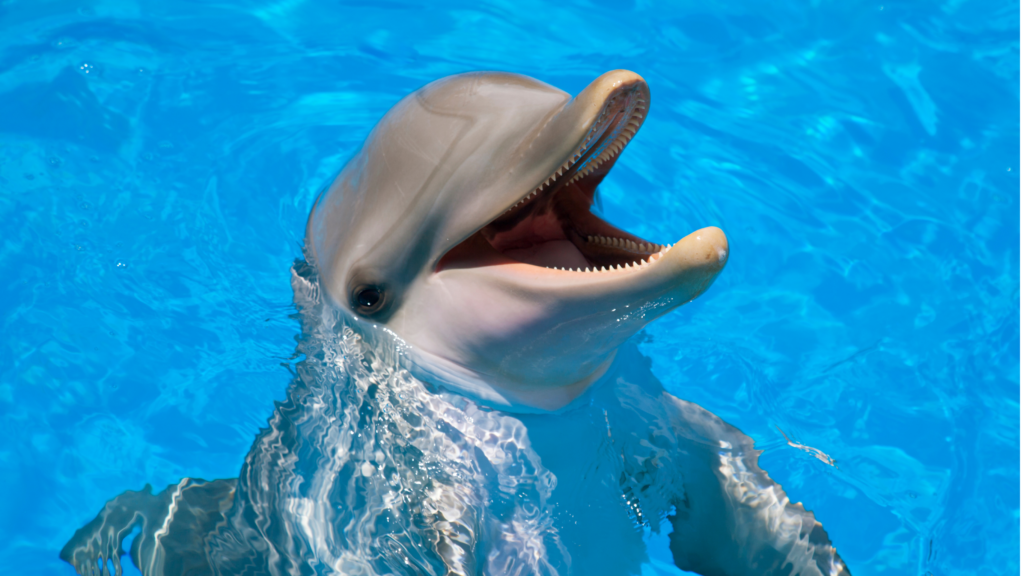
Every time a spinner dolphin surfaces off the Waianae Coast, you are watching a very fast biological transaction. The blowhole opens. Stale air exits in a burst. Fresh air enters. The blowhole closes. The whole exchange takes less than a second, and then the dolphin is underwater again.
What makes that possible, and how long can it actually last before the dolphin needs to return? The answer involves a respiratory system that is genuinely unlike anything on land.
Dolphins are conscious breathers
The first thing to understand about dolphin breathing is that it is voluntary. Humans breathe automatically; our brain stems regulate respiration whether we are awake or asleep, and we only hold our breath when we actively choose to.
Dolphins have no such automatic system. Every breath a dolphin takes requires a conscious decision to surface and open the blowhole. This is part of why dolphins never fully lose consciousness, even during sleep. If a dolphin fell into the kind of deep, unconscious sleep that humans experience, it would stop breathing. The evolutionary solution was unihemispheric sleep, where one hemisphere rests while the other stays awake enough to keep the dolphin breathing and at the surface.
The practical implication is that every aspect of a dolphin’s life, its movement, its social behavior, its rest, is organized around its relationship with the surface.
How long do spinner dolphins hold their breath?
Spinner dolphins, the species that gathers off Oahu’s Waianae Coast each morning, typically hold their breath for 5 to 10 minutes during normal activity. During their nighttime hunting dives, where they pursue prey in the mesopelagic zone hundreds of meters below the surface, individual dives may extend to the longer end of that range or occasionally beyond.
For comparison, here is how other cetaceans perform:
- Bottlenose dolphin: approximately 8 to 10 minutes
- Spinner dolphin: typically 5 to 10 minutes
- Orca: approximately 15 to 20 minutes
- Sperm whale: up to 90 minutes in extreme cases
The variation between species reflects differences in body size, muscle myoglobin concentration, and diving behavior. Spinner dolphins are mid-range divers optimized for repeated, moderately deep dives across a full night of hunting rather than single extreme dives.
The lung efficiency advantage
One of the most striking differences between dolphin and human respiration is how much of the lung the dolphin actually uses in a single breath.
Humans exchange roughly 15 percent of their lung capacity during a normal breath. A dolphin exchanges up to 80 percent in a single surfacing. That efficiency means a dolphin can fully replenish its oxygen supply in a fraction of the time it would take a human, and then dive again almost immediately.
The blowhole itself contributes to this efficiency. Unlike breathing through the mouth and nose, a blowhole opens at the highest point of the dolphin’s body when it breaks the surface, allowing the animal to breathe with minimal disruption to its forward momentum. The visible mist you see above a surfacing dolphin is warm, moisture-saturated air condensing as it meets cooler air outside, not water being expelled.

What makes extended dives possible
Several biological adaptations allow spinner dolphins to stay underwater longer than their lung size alone would suggest.
Myoglobin concentration
Myoglobin is an oxygen-binding protein found in muscle tissue. Dolphins have significantly higher myoglobin concentrations than land mammals of comparable size, which allows their muscles to store and release oxygen independently of what the lungs are supplying. During a dive, the muscles draw on this stored oxygen to continue functioning as the oxygen in the lungs is gradually depleted.
Bradycardia and circulation management
When a dolphin dives, its heart rate slows significantly, a reflex called the diving bradycardia. Blood flow is selectively redirected away from non-essential organs and toward the brain and heart, which have the highest oxygen demands. This conservation strategy extends the window of useful oxygen supply during each dive
Flexible rib cage
Dolphins have a more flexible rib cage than most land mammals, allowing the lungs to compress during deep dives as water pressure increases. Rather than holding a fixed volume of air that would become problematic at depth, the dolphin’s chest can partially collapse and re-expand, reducing the risk of pressure-related injury.
What you see from the boat
On a morning tour off the Waianae Coast, the breathing pattern of the pod tells you something about what the dolphins are doing.
A pod surfacing in tight, synchronized bursts, with multiple animals breathing almost simultaneously, is typically in a resting state. This is the morning rest period after a full night of offshore hunting, and the rhythmic surfacing reflects a group of animals conserving energy while staying near the surface for easy breathing.
When dolphins are more active, playing near the bow or transitioning between resting areas, the breathing becomes less synchronized and more frequent. Animals that are moving fast near the surface may breathe every 30 seconds to two minutes, refreshing their oxygen supply continuously rather than building up a reserve for a long dive.
Calves breathe more frequently than adults. In the first weeks of life, newborn spinner dolphins spend significantly more time at the surface than adult pod members, their smaller lungs and lower myoglobin concentrations limiting the duration of each dive until their physiology matures.
Want to explore more about how spinner dolphins are built for life in the ocean?
👉Return to the Spinner Dolphin Anatomy and Biology guide →
Tours depart from Waianae Boat Harbor, West Oahu, where Hawaii’s spinner dolphins gather every morning.