

Of all the animals on Earth, dolphins are among the few that prompt the question most people instinctively ask when they encounter them for the first time: what is going on behind those eyes? The answer, as researchers have spent decades discovering, is considerably more than most people expect. The cognitive and social lives of dolphins share more structural similarities with human lives than any other marine animal, and in some cases, more than most land animals too.
Here is what the science has actually found.Of all the animals on Earth, dolphins are among the few that prompt the question most people instinctively ask when they encounter them for the first time: what is going on behind those eyes? The answer, as researchers have spent decades discovering, is considerably more than most people expect. The cognitive and social lives of dolphins share more structural similarities with human lives than any other marine animal, and in some cases, more than most land animals too.
Here is what the science has actually found.

Social structures: pods and communities
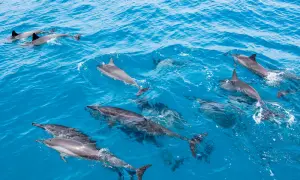
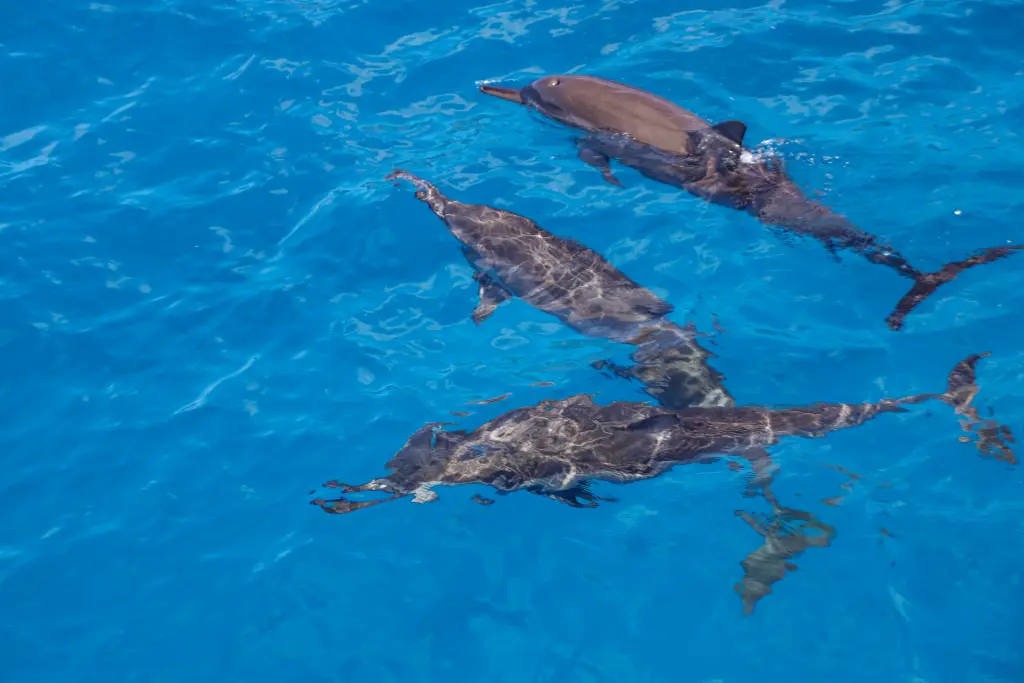
Spinner dolphins live in what researchers call fission-fusion societies, where individuals maintain consistent relationships with specific companions while the size and composition of the group shifts throughout the day. The dolphins that rest together in the shallow bays of the Waianae Coast each morning are not a random assortment of individuals. They are a community with a social history, individual identities, and long-term bonds that can span years or decades.
This kind of social organization, where individuals maintain stable relationships within a fluid group structure, is one of the features most consistently associated with high cognitive capacity in animals. Humans organize their social lives in much the same way: stable inner circles within larger, shifting communities. The parallel is not superficial. It reflects a shared need for the kind of social memory and individual recognition that only cognitively sophisticated animals can maintain.

Communication: more than clicks and whistles
Spinner dolphins communicate through a layered system that includes clicks, whistles, burst-pulse sounds, and body language. Each dolphin develops a unique signature whistle in the first months of life that functions as an individual identifier, and research has shown that dolphins remember the signature whistles of companions they have not seen in over 20 years.
That level of vocal individuality and long-term acoustic memory has no parallel in the animal kingdom outside of humans. We give each other names. Dolphins do too. The mechanism is different, but the function, identifying specific individuals within a complex social network, is the same.
Dolphins also show evidence of regional dialects, where pods in different areas develop slightly different acoustic signatures that are passed down through generations. Cultural transmission of learned behavior, another trait once thought to be uniquely human, is well-documented in dolphin populations worldwide.
Self-awareness and theory of mind
Dolphins are one of only a handful of species that pass the mirror self-recognition test, a standard measure of self-awareness that requires the animal to understand that a reflection is an image of itself rather than another individual. The list of confirmed species includes humans, great apes, elephants, certain corvids, and dolphins.
Self-awareness of this kind is considered a prerequisite for theory of mind, the ability to model the mental states of others. Animals with theory of mind can understand that other individuals have their own knowledge, beliefs, and intentions that differ from their own. This capacity is the foundation of empathy, deception, cooperation, and most of what humans consider social intelligence. Dolphins show behavioral evidence of all of these.

Emotional intelligence: joy, grief, and empathy
Dolphins have been documented staying with deceased companions for days, showing behavioral changes after the loss of a pod member that are consistent with grief responses in humans and other highly social animals. This is not an isolated observation. Researchers have documented similar behavior across multiple dolphin species and populations.
Dolphins also show empathy in experimental settings, responding to the distress of other dolphins in ways that go beyond simple proximity. And play, which is one of the most reliable indicators of positive emotional states in mammals, is a behavior dolphins engage in throughout their entire lives, not just as juveniles.
The emotional range documented in dolphins, including joy, grief, fear, and what appears to be something like attachment, maps closely onto the emotional architecture that humans recognize in themselves and each other.
Problem solving and tool use
Wild dolphins use sea sponges, giant shells, and mud rings as tools during hunting, and these behaviors are passed down culturally rather than encoded genetically. The ability to use objects as tools and to teach that use to the next generation was, until relatively recently, considered a defining feature of human intelligence. Dolphins are now on the list of species that do both.
In problem-solving experiments, dolphins demonstrate flexible reasoning, the ability to approach a novel problem from multiple angles rather than applying a fixed behavioral response. This cognitive flexibility is what allows both humans and dolphins to adapt to environments and challenges that their ancestors never encountered.

Play throughout a lifetime
Dolphins play their entire lives, not just as calves learning skills. Adult spinner dolphins ride bow waves, produce bubble rings, toss objects, and engage in social games that serve no immediate survival function. Play in adults is one of the strongest behavioral indicators of a large, flexible brain with capacity to spare, and it is one of the traits that most reliably separates cognitively sophisticated species from simpler ones.
On a morning tour off the Waianae Coast, the spinning leaps and bow-riding you see are not performances. They are what adult dolphins in good health, with full bellies and stable social bonds, choose to do with their time.
What do the similarities mean when you are on the water
None of the cognitive parallels described above are metaphors. They are documented findings from peer-reviewed research conducted on wild and studied dolphin populations over decades. When you watch a pod of spinner dolphins off the Waianae Coast, you are watching animals that know each other by name, remember companions across years, feel the weight of loss, and choose to play even as adults.
The experience of watching them changes when you understand what is actually happening inside those pods. These are not simply beautiful animals moving through beautiful water. They are individuals with social histories, emotional lives, and cognitive capacities that overlap meaningfully with our own.
Join us on the Waianae Coast and see it for yourself.

Want to explore more about how Hawaii’s spinner dolphins think and behave?
👉Return to the Dolphin Behavior and Intelligence guide →
Tours depart from Waianae Boat Harbor, West Oahu, where Hawaii’s spinner dolphins gather every morning.