





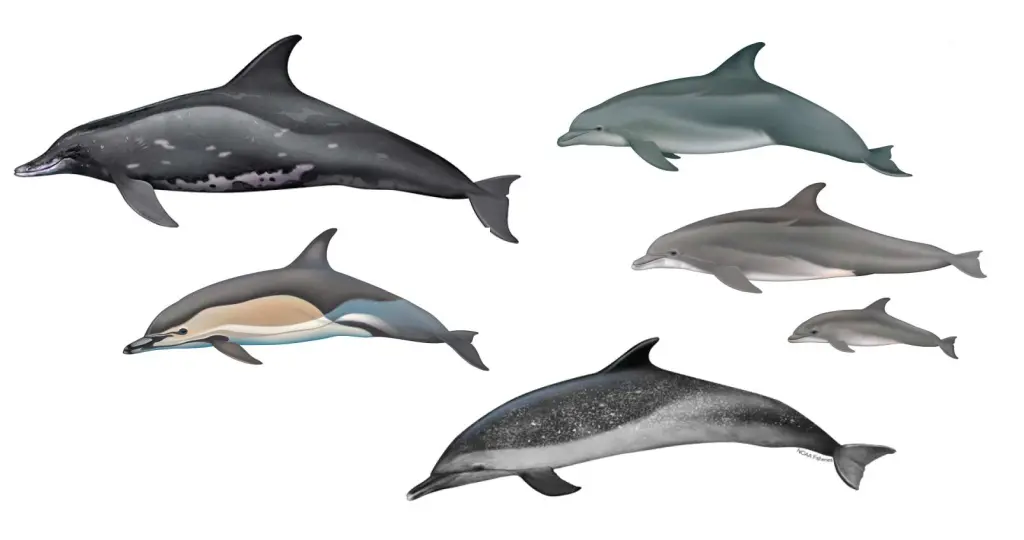
When most people think of dolphins in Hawaii, they picture the spinner dolphin. That image is accurate, as far as it goes. Hawaiian spinner dolphins gather off Oahu’s Waianae Coast every morning, and they are the species most tour guests encounter. But Hawaii’s waters support a much broader range of cetacean life than most visitors realize, and several other dolphin species appear regularly in Hawaiian waters, each with its own habitat, behavior, and appearance.
Here is a complete guide to the dolphin species found in Hawaii.
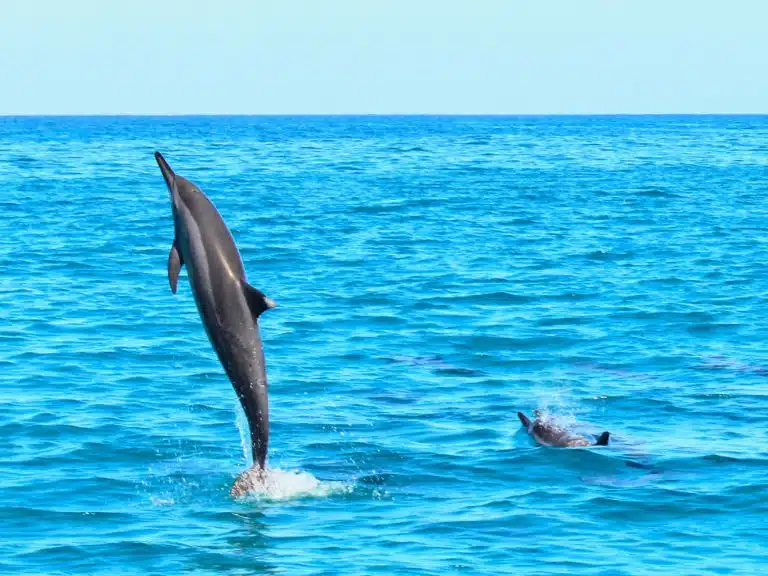
The Hawaiian spinner dolphin, Stenella longirostris, is the species you are most likely to encounter on a morning tour off the Waianae Coast. They are a small, slender dolphin, typically five to seven feet in length and weighing between 130 and 170 pounds, making them one of the smaller dolphin species found in Hawaiian waters. They have a distinctive three-tone color pattern: dark gray on the back, a lighter gray band along the sides, and a white or pale yellow belly.
Their most recognizable behavior is the aerial spin that gives them their name. Spinner dolphins launch themselves out of the water and rotate on their long axis, sometimes completing several full rotations before re-entering. The behavior is believed to serve multiple purposes, including communication, parasite removal, and play.
Hawaiian spinner dolphins follow a consistent daily rhythm. They hunt in deep offshore water at night and return to shallow coastal bays in the morning to rest and socialize. That predictable pattern is why morning tours reliably encounter them. They are year-round residents of Hawaiian waters, with stable pods that use the same coastal areas across generations.
👉Learn more about spinner dolphin behavior and intelligence in Hawaii →
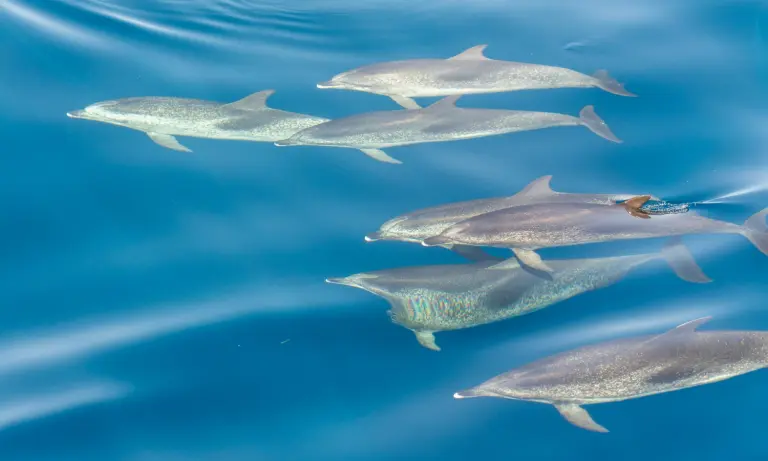
Pantropical spotted dolphins, Stenella attenuata, are one of the most commonly seen dolphin species in Hawaiian offshore waters. Adults develop the distinctive black-and-white spotting pattern that gives the species its name, though calves are born without spots and develop them gradually as they mature. Adults grow to around six to eight feet in length and weigh between 180 and 250 pounds.
They are a fast, energetic species, frequently seen riding bow waves and leaping clear of the water in large groups. Unlike spinner dolphins, which have predictable nearshore resting habits, pantropical spotted dolphins tend to be found farther offshore and are less consistently present in the same locations.
In Hawaiian waters, they are often encountered in large groups of 100 or more individuals. They are one of the species that guests on an offshore dolphin tour may encounter alongside or instead of spinner dolphins, particularly later in the morning as spinner dolphins move farther from shore.
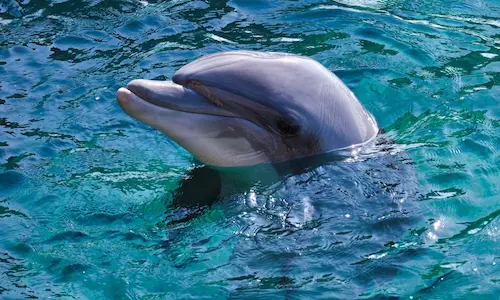
The bottlenose dolphin, Tursiops truncatus, is the species most people picture when they hear the word dolphin. Adults reach up to 12 feet in length and weigh between 400 and 600 pounds, making them significantly larger than the spinner dolphins most visitors expect to see. They have a robust gray body, a shorter snout, and a distinctive curved dorsal fin.
In Hawaiian waters, bottlenose dolphins are seen year-round. They are adaptable animals, comfortable in both shallow coastal waters and deeper offshore environments. Bottlenose dolphins are among the most extensively studied species in cetacean research, with documented abilities in problem-solving, tool use, and long-term social memory that have shaped much of what we understand about dolphin cognition.
Hawaiian bottlenose dolphins are sometimes seen on dolphin tours, particularly when pods are traveling along the coast or in the channels between islands.
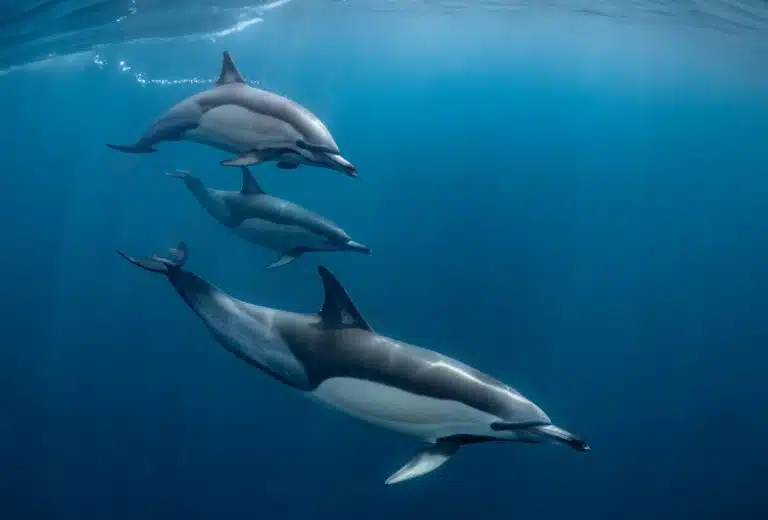
Short-beaked common dolphins, Delphinus delphis, are a widespread species found throughout the Pacific, including Hawaiian waters. They are immediately recognizable by their distinctive hourglass color pattern on the sides, a sweeping combination of yellow-tan and light gray that contrasts sharply with the darker back and white belly. They grow to around seven feet in length and weigh between 150 and 200 pounds.
They are highly social and often found in very large groups, sometimes numbering in the hundreds or thousands. In Hawaiian waters, they tend to appear in offshore or open-ocean environments rather than the nearshore bays where spinner dolphins rest.
Their behavior at the surface is energetic: frequent leaping, active bow riding, and fast, purposeful movement are characteristic of the species. Common dolphins are among the fastest dolphin species, capable of sustained speeds that allow them to cover large distances across open water.
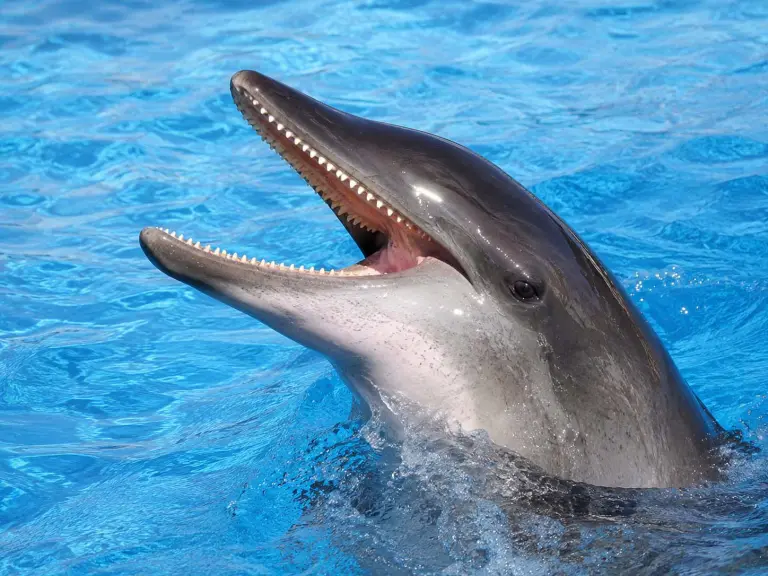
The rough-toothed dolphin, Steno bredanensis, is one of the least familiar species to most visitors but is a year-round resident of Hawaiian offshore waters. They are named for the distinctive wrinkled or ridged texture of their teeth, a characteristic unique to this species. Adults range from seven to nine feet in length and weigh between 200 and 350 pounds, placing them solidly between a spinner dolphin and a bottlenose in size.
Their appearance is unusual compared to other Hawaiian dolphins. The head lacks the distinct forehead crease that separates the melon from the snout in most species, giving rough-toothed dolphins a long, continuous profile from forehead to beak tip. The back and upper body are dark gray, while the lips and sides are often marked with irregular white or pale blotches that make individual identification possible.
Rough-toothed dolphins prefer deep offshore water and are rarely seen close to shore. They hunt large prey, including substantial fish and squid, and have been documented playing with prey at the surface before consuming it. NOAA research has documented resident populations around Kauai, Ni’ihau, and other Hawaiian Islands.
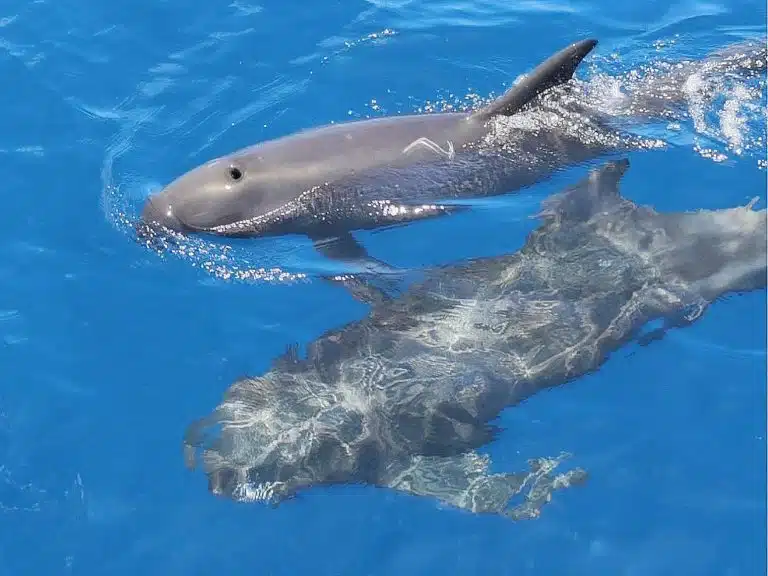
Risso’s dolphins, Grampus griseus, are one of the larger dolphin species found in Hawaiian waters, reaching up to 13 feet in length and weighing between 660 and 1,100 pounds. They are unmistakable in appearance: older individuals become almost entirely white due to accumulating scars from prey and social interactions, overlaid on a body that starts out dark gray. Every adult Risso’s dolphin carries a unique pattern of white scars that serves as an individual identifier.
They are primarily offshore animals, preferring deep water where squid, their main prey, are most abundant. Sightings in Hawaiian waters tend to occur well offshore, and they are not commonly encountered on nearshore dolphin tours. When seen, they are typically in small, tight groups moving steadily through the water column.
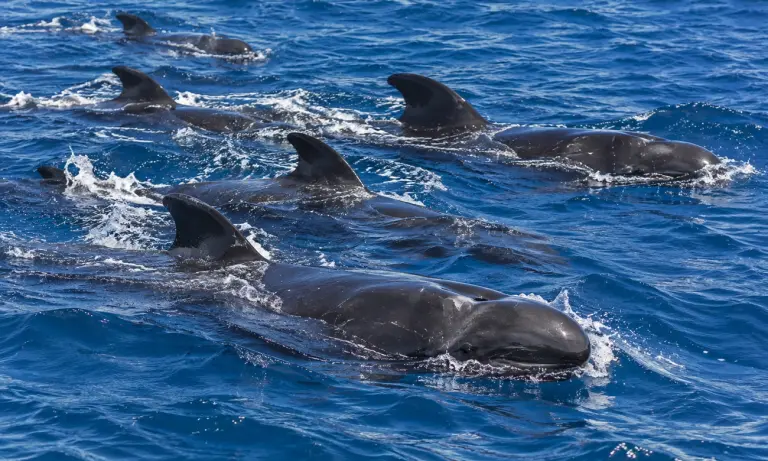
Two additional species that appear in Hawaiian waters deserve mention, as both are sometimes encountered on offshore tours.
False killer whales, Pseudorca crassidens, are large, slender cetaceans that despite their name are more closely related to dolphins than to orca. They are dark gray to black, reaching up to 20 feet in length and weighing up to 1,500 pounds, and are known for sharing prey with other pod members and occasionally with humans on boats. Hawaii has a resident population of false killer whales designated as endangered under the Endangered Species Act.
Melon-headed whales, Peponocephala electra, reach around eight to nine feet in length and weigh between 350 and 460 pounds, appearing in tight, fast-moving groups of dozens to hundreds of individuals. They are regularly found in Hawaiian offshore waters and are occasionally seen from tour vessels traveling in deeper channels.
Hawaiian spinner dolphins are the primary species encountered on morning tours along the Waianae Coast. Their predictable nearshore resting behavior, stable pod structure, and year-round presence make them the most reliable dolphin species for guided viewing in Oahu.
Pantropical spotted dolphins and bottlenose dolphins are also encountered on Dolphins and You tours, particularly on days when pods travel close to the tour route. Other species, including rough-toothed dolphins and false killer whales, are less predictable but have been observed by Dolphins and You guests over the company’s 35 years of operation.
The ocean does not operate on a fixed schedule. What you see on any given morning is a function of what is in the water that day.
👉Join us on the Waianae Coast and see for yourself.
Want to learn more about Hawaii’s dolphins and the best ways to see them?
Dolphins and You · Oahu, Hawaii
Spinner dolphins gather off the Waianae Coast every morning, and on a good day, you may encounter pantropical spotted dolphins or bottlenose dolphins too. Join Dolphins and You for a morning tour and see what is actually out there.
4.9 ★
Google & TripAdvisor
35 yrs
in business
Wild
100% wild dolphins
Tours depart from Waianae Boat Harbor, West Oahu, where Hawaii's spinner dolphins gather every morning.
