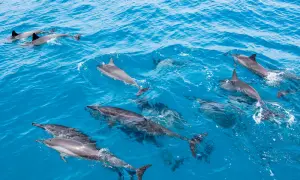



If you have ever watched a dolphin race alongside a boat and felt like it was barely trying, you were not imagining it. Dolphins are genuinely fast in the water, faster than most people expect, and the way they move through the ocean is one of the more elegant solutions to the problem of speed that evolution has ever produced. Hawaiian spinner dolphins, the species most commonly seen on Oahu dolphin tours along the Waianae Coast, are no exception. Understanding what is actually happening when a dolphin streaks past you changes the experience of watching one completely.
The Numbers That Catch People Off Guard
Hawaiian spinner dolphins can reach burst speeds of around 20 miles per hour, with some individuals recorded closer to 25 miles per hour during short sprints. Bottlenose dolphins, the species most people recognize, cruise comfortably at 7 to 8 miles per hour but can accelerate to 18 to 22 miles per hour when they want to. Common dolphins, a species found in many temperate and tropical oceans, are among the fastest, with documented bursts reaching 25 miles per hour in open water.
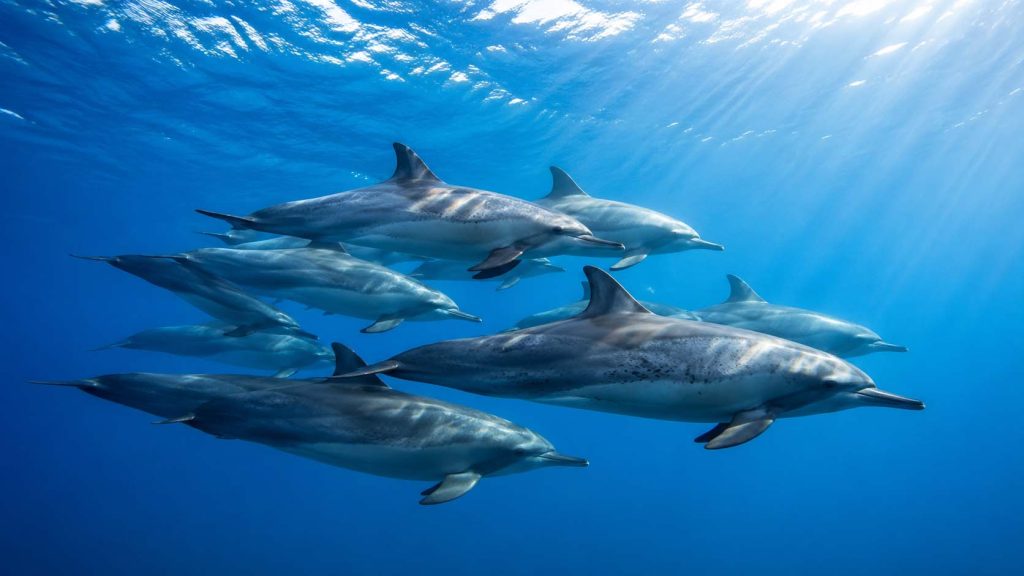
To put those numbers in context, the fastest human swimmers in competition elite level, moving through the water in a controlled pool, top out at around 5 miles per hour. An average person swimming in the ocean is moving at closer to 2 miles per hour. A dolphin cruising at a moderate pace is traveling roughly three to four times faster than a person working hard. A dolphin in a full sprint is doing something that would feel, to a human swimmer, like being passed by a car on the highway.
- Hawaiian spinner dolphins: burst speeds up to 20 to 25 mph
- Bottlenose dolphins: cruising at 7 to 8 mph, sprinting to 18 to 22 mph
- Common dolphins: among the fastest, documented at 25 mph in open water
- Elite human swimmers: approximately 5 mph at maximum effort in a pool
Why Dolphins Move the Way They Do
Most of what makes a dolphin fast is invisible at first glance. The key is in the tail. Dolphin flukes are horizontal blades that move up and down, which is different from nearly every fish you can think of, where the tail fin is vertical and sweeps side to side. That up-and-down motion is a mammalian trait. Land mammals that run fast, think of a cheetah at full sprint, flex their spines up and down rather than side to side. When dolphins evolved from land-dwelling ancestors back into the sea around 50 million years ago, they kept that spinal motion. It got repurposed from galloping on land to driving a set of horizontal flukes through water, and the result is one of the most efficient propulsion systems in the animal kingdom.
The dolphin’s body shape does the rest. No external ears. No legs. No protruding joints. Even the reproductive organs and nipples are housed internally or in retractable slits that close flush with the body while swimming. Every feature that could create drag has been streamlined away over millions of years. The skin itself plays a role: research has shown that the texture of dolphin skin can shift at a microscopic level in response to water flow, reducing turbulence in a way that engineers have spent decades trying to replicate in submarines and racing hulls.
Porpoising: The Speed Trick You Can See From the Deck
When a pod of dolphins is really moving and you see them launching out of the water repeatedly in long, low arcs, that behavior has a name: porpoising. And it is not just showing off.
Water creates significantly more resistance than air. At lower speeds, staying submerged and swimming continuously is the most efficient approach. But above approximately 11 miles per hour, the energy cost of pushing through dense water at that pace starts to exceed the cost of repeatedly breaking the surface, flying briefly through air, and re-entering the water. So fast-moving dolphins switch to porpoising as an energy-saving strategy. The leap through air is not a celebration or a distraction. It is the most efficient way to travel at high speed in a medium as dense as the ocean. What looks like play from the deck of a boat is actually precision fuel management.
Bow-Riding: How Dolphins Get a Free Ride
Another speed behavior that guests on dolphin tours almost always notice is bow-riding. When a vessel is moving through the water, it creates a pressure wave that builds up at the bow of the hull. Dolphins discovered, or evolved to exploit, the fact that positioning themselves right at the leading edge of that wave gives them a forward push without any effort on their part. The wave does the work. The dolphin rides it like a surfer riding a swell, adjusting position with subtle body movements and traveling at boat speed while barely moving their flukes at all.
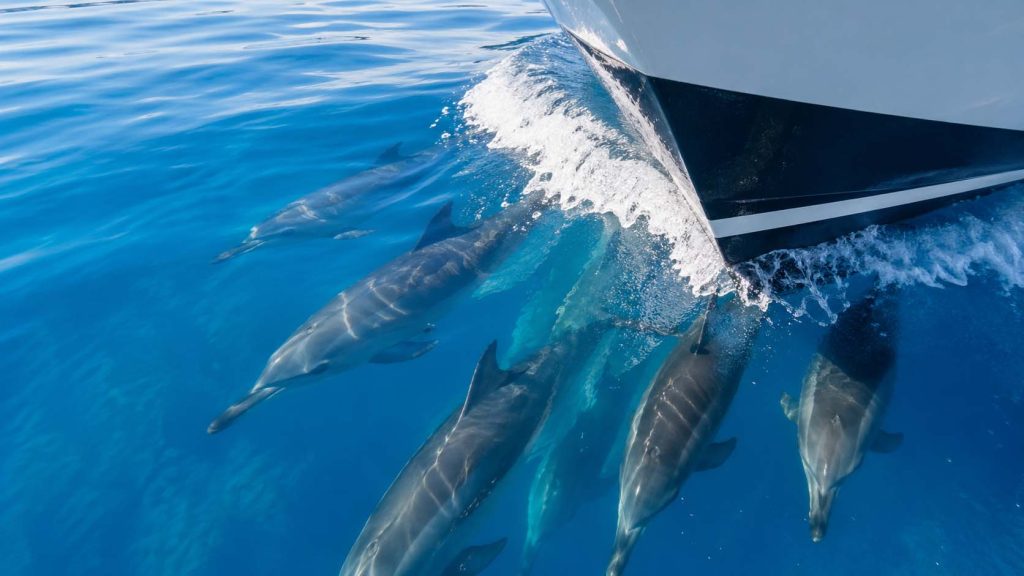
This is not random behavior. Wild dolphins will swim toward a boat from a considerable distance specifically to get on the bow wave. They will jostle for position within a pod when a good wave is available. They appear to enjoy it, and there is good reason to think they do, but the behavior also has a clear practical benefit: free speed with no energy cost. It is one of the clearest examples of how intelligent, opportunistic, and physically capable these animals are all at once.
Hawaiian Spinner Dolphins and What Speed Means in Their World
Hawaiian spinner dolphins, Stenella longirostris, are medium-sized dolphins that typically measure four to seven feet in length and weigh between 130 and 170 pounds. They are named for their signature aerial behavior, launching out of the water and spinning on their longitudinal axis, sometimes completing up to seven full rotations in a single jump. That kind of aerial agility requires the same speed, body control, and physical precision that makes them such effective hunters.
During the day, spinner dolphins rest in shallow, sheltered bays along the Waianae Coast, where the water is calm, and they can conserve energy. But at night, they move offshore into deeper water to hunt. Their prey, small fish, squid, and shrimp, migrate up toward the surface in the dark, and the dolphins follow. Speed matters in those nighttime hunts. They use echolocation to track and target prey in complete darkness, and their ability to accelerate quickly and change direction in fractions of a second is what makes them effective predators rather than just fast swimmers. A dolphin that could only go fast in a straight line would not last long in the open ocean at night. The speed and the agility come as a package.
What You See on the Dolphins and You Tour
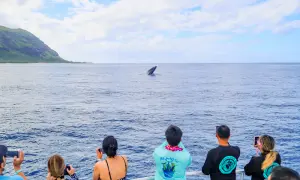
Numbers and biology can tell you a lot, but there is something about watching wild spinner dolphins in real time that the data cannot fully capture. When the boat heads out from Waianae Boat Harbor along the coast, the dolphins that appear and take up position at the bow are not performing for the guests. They are doing what they do, which happens to be one of the more remarkable physical acts in the ocean. Watching a pod accelerate from rest to full sprint, adjust their position relative to the hull, and communicate with each other while doing it gives you a feel for their speed that numbers alone do not.
The Dolphins and You tour departs at 8:00 AM and 12:00 PM daily and runs approximately three hours along Oahu’s Waianae Coast. Snorkel equipment, lunch, and a live Hawaiian cultural performance are included. The spring discount code Spring20 takes 20 percent off the standard rate, and early bird bookings of 30 or more days in advance qualify for 50 percent off.
Built for It, Every Inch
Fifty million years of evolution have produced an animal that is about as well-suited to moving fast through water as anything on the planet. The flukes, the spine, the skin, the behavior, the social coordination of a hunting pod at night: all of it points in the same direction. When you watch a spinner dolphin streak past the boat in a low, fast arc and disappear into blue water in under a second, you are seeing the end result of that long process. It is fast because it had to be, and because everything unnecessary has been stripped away. That is worth standing at the rail for.
Want to explore more about how Hawaii’s spinner dolphins think and behave?
👉Return to the Dolphin Behavior and Intelligence guide →
Tours depart from Waianae Boat Harbor, West Oahu, where Hawaii’s spinner dolphins gather every morning.