





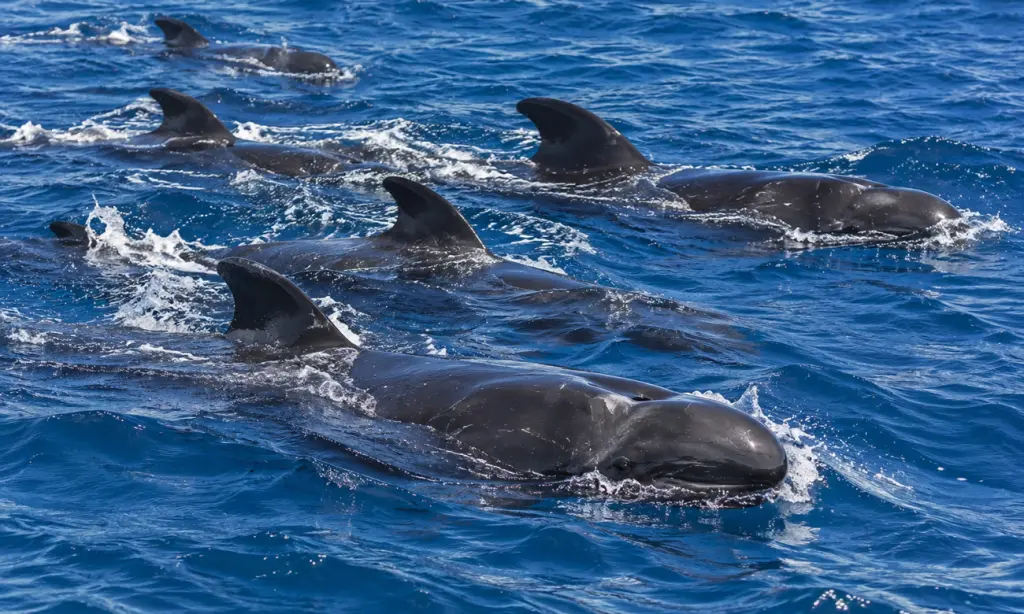
Most visitors to Oahu come hoping to see spinner dolphins. What they do not expect is to find themselves alongside a pod of large, dark, fast-moving animals that look nothing like what they imagined. False killer whales are one of the ocean’s most surprising encounters, and Hawaiian waters are among the best places in the world to find them.
Despite the name, false killer whales are not whales at all. They are dolphins. Pseudorca crassidens belongs to the family Delphinidae, the same family as spinner dolphins, bottlenose dolphins, and orcas. False killer whales are one of the larger members of that family, reaching up to 20 feet in length and weighing up to 1,500 pounds, but they share the same fundamental biology, social structure, and intelligence as their smaller dolphin relatives.
The confusion around the name is understandable. False killer whales are large, dark, and powerful. They look more like something you would expect to call a whale. But spend time watching them and the dolphin characteristics become clear: the social dynamics, the playful behavior, the speed, and the curiosity toward boats.
The name comes from the skull. When the species was first described in the 19th century, scientists identified it from fossil remains and noted that the skull structure closely resembled that of an orca. The “false” prefix was added to distinguish it from the killer whale, and the name stuck despite being consistently confusing ever since.
The behavioral similarities to orcas are real but limited. Like orcas, false killer whales are apex predators that hunt large prey, including fish and squid. Unlike orcas, they are true members of the dolphin family and share far more in common with bottlenose dolphins than with any species of whale.
Hawaii has a resident population of false killer whales, and it is one of the most studied populations in the world. The main Hawaiian Islands stock is listed as endangered under the Endangered Species Act, with an estimated population of around 150 to 200 individuals.
These animals are year-round residents of Hawaiian waters, unlike humpback whales, which visit seasonally. They are primarily found in deeper offshore waters around the main Hawaiian Islands, where they hunt fish and squid in the water column. They do not follow the same predictable nearshore resting pattern that makes spinner dolphins so reliably visible off the Waianae Coast.
Their endangered status reflects the pressures they face in Hawaiian waters: interactions with longline fishing gear, which can result in injury or death, and competition for prey species. NOAA has ongoing research and management programs focused on this population, and sighting data from tour operators contributes to that monitoring effort.
False killer whales are large and uniformly dark, ranging from dark gray to nearly black across the entire body. They have a rounded, melon-shaped forehead with no distinct beak, which gives them a blunter profile than most dolphins.
The dorsal fin is distinctive: falcate (curved backward) and positioned near the middle of the back. The flippers have a unique S-curve or hump on the leading edge that is characteristic of the species and helps with identification at sea.
Their size alone sets them apart from the spinner dolphins most tour guests are used to seeing. Where a spinner dolphin might be five to seven feet long, a false killer whale can be three to four times that length. When a pod appears alongside a boat, the scale difference is immediately apparent.
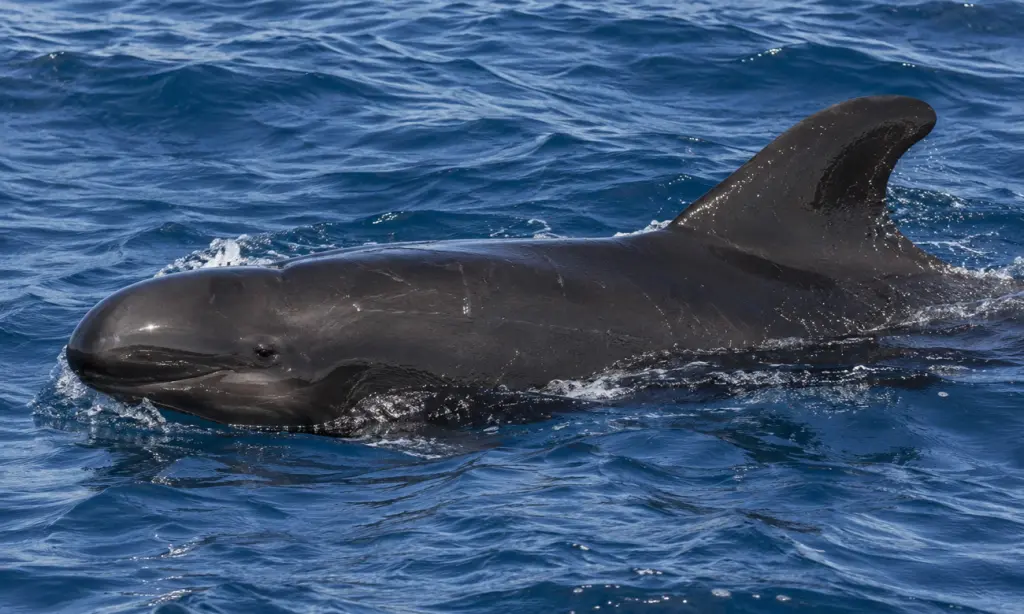
False killer whales are highly social animals that live in tight, stable groups of 10 to 50 individuals. They are known for one behavior that is unusual even among dolphins: food sharing. False killer whales have been documented offering prey to other pod members, and occasionally to human divers and researchers in the water nearby.
They are fast swimmers capable of reaching speeds comparable to the fastest dolphin species, and they are aerial: breaching, spy-hopping, and bow-riding are all documented behaviors. Like other dolphin species, they play throughout their lives, not just as juveniles.
False killer whales are also known to associate with other species. Mixed groups with bottlenose dolphins have been documented in Hawaiian waters, and these associations appear to be stable over time rather than incidental encounters.
It is possible, though not predictable. False killer whales are not the target species on a Dolphins and You morning tour, and their offshore habitat means they appear less frequently than spinner dolphins. But they have been spotted by our guests over the company’s 35+ years of operation, and when they do appear, it is one of the most memorable wildlife encounters the ocean can produce.
The spinner dolphins that gather off the Waianae Coast every morning are the reliable highlight of every tour. False killer whales, if they appear, are the unexpected bonus.
Join us on the Waianae Coast and see what the ocean decides to show you. On a good morning, it might be more than you expected.
Want to learn more about the marine life you might encounter in Hawaiian waters?
Dolphins and You · Oahu, Hawaii
Spinner dolphins are the reliable highlight of every morning tour off the Waianae Coast. False killer whales, rough-toothed dolphins, and other offshore species are the unexpected bonus. Join Dolphins and You and see what shows up.
4.9 ★
Google & TripAdvisor
35 yrs
in business
Wild
100% wild dolphins
Tours depart from Waianae Boat Harbor, West Oahu, where Hawaii's spinner dolphins gather every morning.
