


Hawaiian green sea turtles are native, beloved creatures that chill in the beautiful waters of Hawaii. You can find them commonly at many beaches around Hawaii, some more than others. Before you go out of your way to go and find wild Hawaiian green sea turtles during your stay in Hawaii, it is recommended that you become familiar with them and things you should keep out for. Here is a comprehensive list showing 10 things you should know about Hawaiian green sea turtles.
1. About Hawaiian Green Sea Turtles
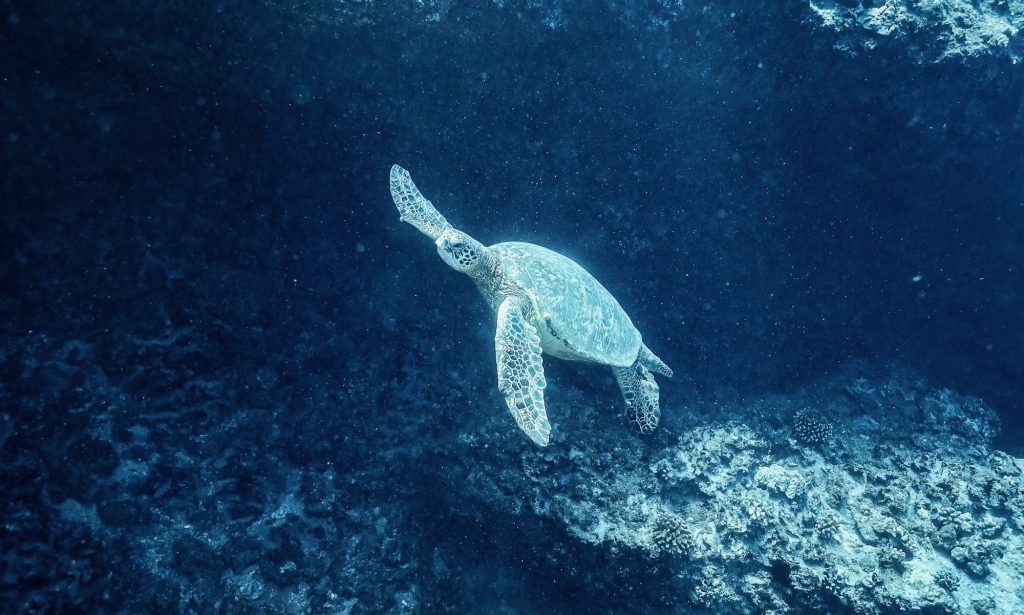
Hawaiian green sea turtles in Hawaiian are known as “Honu”. They are the largest hard-shell sea turtles in the world. Their diet consists of jellyfish from a young age. But as they grow older, they start to have more of a vegetarian diet, including seaweed, seagrass, and algae. Adult sea turtles can grow up to around 3 to 4 feet (0.9 to 1.2 meters). They can also weigh upwards of 350 pounds (158.8 Kilograms). Their life span is pretty long, comparable to that of a modern human, living around 60 to 80+ years old!
2. How to Tell The Gender of a Sea Turtle
Hawaiian green sea turtles are sexually dimorphic, meaning that they do not look completely different depending on the gender. But there are two main ways that you can find out the gender of Hawaiian green sea turtles. One way is to look at specific features of the turtle when they are fully mature. When you take a look at fully matured Hawaiian green sea turtles, which are around the age of 20-30, male and female sea turtles tend to grow some features that help differentiate them.
The main feature that notably changes is the size of the tail. Male sea turtle tails tend to be way longer, as that is where the reproductive system of the turtle sits. On the other hand, female sea turtle tails are very short and stubby. There are other ways you can tell physically, also, such as the length of the claws, but it depends on the type of sea turtle.
Another way to tell the gender of a sea turtle is to do a procedure called laparoscopy. This surgical procedure is done by inserting a laparoscope, which is a tube that has a light and a camera at the tip of it, into an incision made in the abdomen. This procedure can be done to see whether or not the young sea turtle has a white ovary and an immature oviduct.
3. Turtle Gender Isn’t Determined as You’d Expect
Sea turtles are unique in that when the eggs are laid in the sand, they don’t have a gender. Their gender is actually determined by the temperature of the sand that they are lying in. This is called temperature-dependent sex determination, or TSD for short. You can often see this occurrence within sea turtles, alligators, and crocodiles.
In the case of sea turtles, if the egg incubates below around 81.86ºF (27.7ºC), it will create male hatchlings, while on the other hand, if the incubation temperature exceeds 87.8ºF(31ºC), it will create female hatchlings. If the temperature fluctuates or is in between, which is also referred to as the pivotal temperature, it can lead to a mixed batch of hatchlings. Knowing this, climate change does affect this, as there is a notable change in the ratio of male to female sea turtles in the wild due to climate change.
4. Significance in Hawaiian Culture
In old Hawaii, Hawaiian green sea turtles were raised and farmed in fish ponds by the ali’i, or the high chiefs of Hawaii. These turtles would then be used for many purposes. The meat would be regularly eaten, while the shell would be used as a container. The other bones of the turtle are used to make a multitude of items, such as tools, jewelry, and fish hooks. But not all families did this during those times. The reason for this is that some believed that sea turtles were ʻaumākua, or family deities, who protected them.
5. Protected Species
In Hawaii, there are multiple animals that are protected under law in order to help with their preservation of the species. One of these animals would include all sea turtles of Hawaii. By law, there are some things that are absolutely prohibited, or else you could receive a fine that could go up to around $10,000! These would include touching the sea turtle, feeding them, or going within any vicinity of them. It is advised that people viewing sea turtles do so from at least 10 feet away.
6. Habitat
Hawaiian green sea turtles live along the Hawaiian archipelago. They mainly travel to the main islands of Hawaii for food and to rest on the beaches. When it comes to nesting, around 95 percent of it is done further down the Hawaiian archipelago. More specifically, on the French Frigate Shoals in the Papahānaumokuākea Marine National Monument.
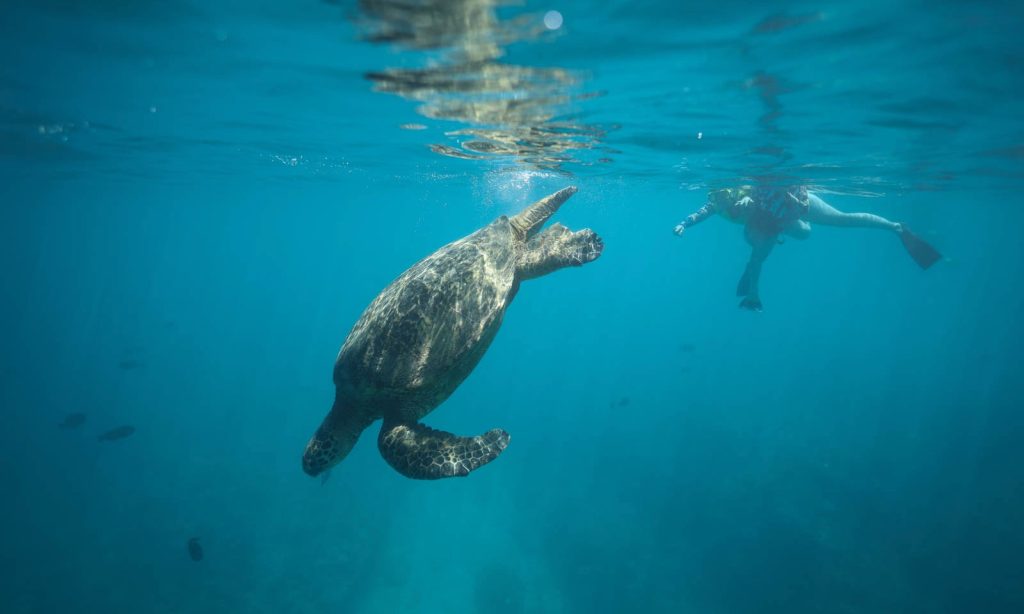
They also enjoy cruising around the main Hawaiian islands. One popular spot they often visit is Turtle Canyon, about 2 miles (3.2 kilometers) off the coast of Waikiki. Since this area is a cleaning station, sea turtles often come here to get cleaned by the local fish. If you are interested in snorkeling and swimming among not only the many sea turtles, but also the abundant marine life, we highly recommend joining the best turtle snorkeling tour in Oahu, Turtles and You!
👉 Learn more about our turtle snorkeling tour here →
7. Diet
The diet of Hawaiian green sea turtles is interesting. When they are little hatchlings, they mostly eat fish and plants. But as they grow up around the age of 6 to 7, they start to switch to a more herbivorous diet. For example, they would eat mostly algae, seaweed, and seagrass. On top of this, more mature turtles also like to snack on invertebrates such as jellyfish once in a while!
8. Threats
There are a lot of threats to the Hawaiian green sea turtles. One major threat to the species as a whole is climate change. As we mentioned previously, sea turtles have temperature-dependent sex determination, meaning that the temperature of the sand on which they are laid determines the gender of the sea turtle. But due to climate change, it has been shown that the population of sea turtles based on gender alone has stagnated. Research shows that there is an imbalance, with female sea turtles our numbering the amount of male sea turtles being born.
9. Hawaiian Green Sea Turtles Are Not Called Green Because of Their Shell
Hawaiian green sea turtles’ shells are almost brownish in color with streaks of green and yellow, with a light yellow underside. But they are not called green because of this. The reason they are called green is that their fat and collagen are green. This is because due to the fact that their diet consists mainly of algae!
10. Common Places You Can Observe Wild Sea Turtles
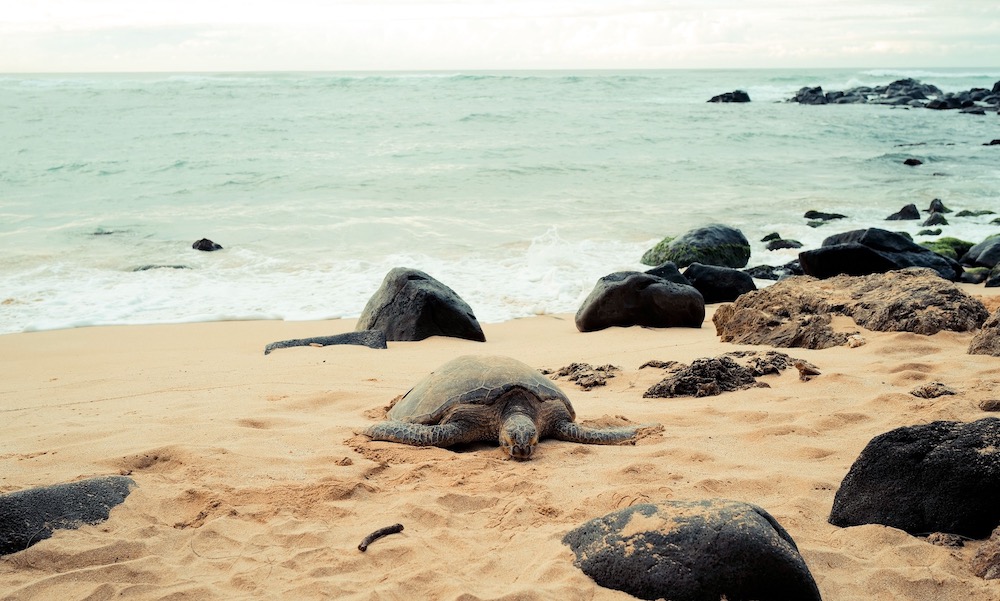
There are many places on Oahu where you can find sea turtles in the wild while respecting their space and following the law. One common location is Laniakea Beach. This beach, also known as Turtle Beach, is located in Haleiwa on the North side of Oahu. This beach is very well-known for the fact that it is incredibly common to see wild sea turtles chilling on the sand. We recommend going early in the morning to check this location out, as it can get pretty crowded throughout the day. Another popular location is Puaʻena Point Beach Park. Here is a common location where you can see wild Hawaiian sea turtles. We also go and check out this location on our “Island and You” Oahu circle tour, where we take guests around the island of Oahu, experiencing scenic locations, Hawaiian culture, and tasty local food!
👉 Learn more about our Oahu circle island tour “Island and You” here→
Experiencing Wild Hawaiian Green Sea Turtles
Experiencing Hawaiian green sea turtles is a very exciting experience for many, but it is also important to understand them as a whole. If you are interested in learning more not only about sea turtles, but also the local marine life of Hawaii, then you should check out our Marine Life in Oahu guide!
👉 Learn more about the marine life in Oahu here→
Wild Hawaiian green sea turtles are frequently spotted at snorkeling locations along Oahu’s west coast. Guests on our Dolphin and You tour often encounter sea turtles while snorkeling after searching for wild dolphins.
Along the way, you may also see tropical fish and other incredible marine life native to Hawaii.
👉 Check availability for the Dolphin and You tour