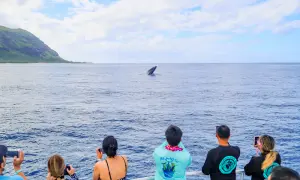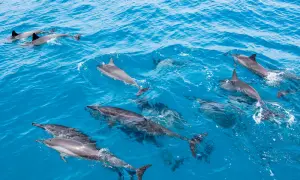



Every morning along Oahu’s Waianae Coast, pods of Hawaiian spinner dolphins return to the same shallow bays to rest. They do it without fail, day after day, year after year. No GPS. No visible landmarks above the water. No map of any kind. And yet they always know exactly where they are. How a dolphin finds its way across open ocean and back to the same stretch of coastline is one of the more remarkable stories in all of marine biology. It turns out that dolphins do not rely on a single navigation tool. They use several of them at once, and the combination is extraordinarily effective.
Echolocation: Sound Becomes a Picture
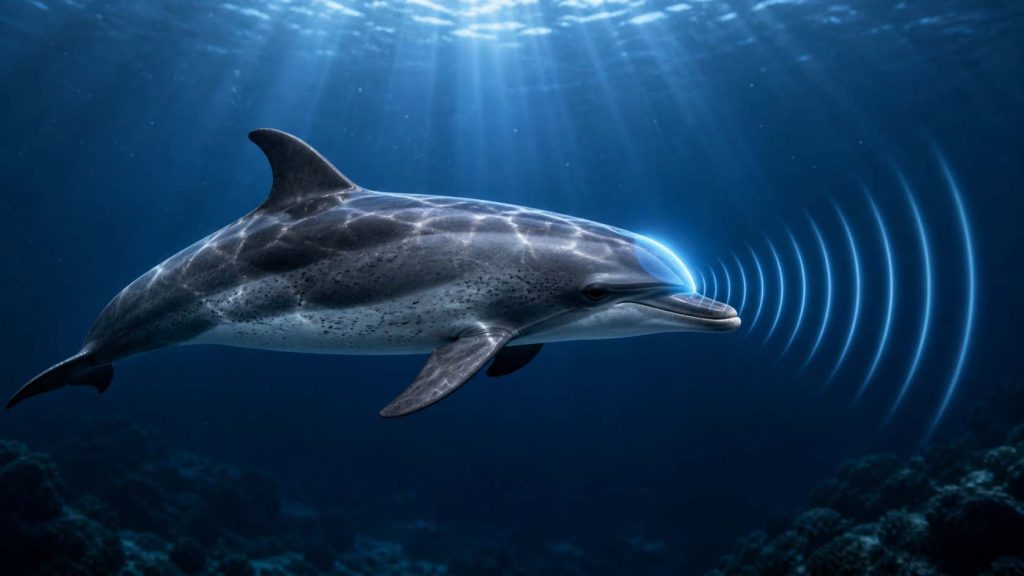
The navigation tool most people associate with dolphins is echolocation, and for good reason. Dolphins produce rapid bursts of clicking sounds inside their nasal passages, then project those sounds outward through a specialized fatty organ in their forehead called the melon. The melon acts as a biological lens, focusing and directing the clicks into a tight beam in front of the dolphin.
When those sound waves hit an object such as a reef, another animal, the seafloor, or a school of fish, they bounce back. The returning echoes travel back through the dolphin’s lower jaw, along fat-filled channels, and into the inner ear. The dolphin’s brain processes the returning signals with extraordinary speed, building a three-dimensional picture of what is in front of it. This system works in complete darkness, in murky water, and at night. Spinner dolphins feed after dark in the open ocean, and echolocation is what allows them to locate and chase fast-moving prey in conditions where vision is essentially useless.
For navigation over short and medium distances, echolocation is the primary tool. A dolphin can detect the shape of a reef, the edge of a bay, and the bottom rising beneath it in real time, adjusting its path continuously based on the sound picture it receives.
A Magnetic Sense Hidden Inside
Echolocation is powerful, but it works best at shorter ranges. For navigating across open ocean, scientists believe dolphins rely on something else as well: a biological sensitivity to Earth’s magnetic field. Research has found particles of magnetite, an iron-based mineral, embedded in the brain tissue of various marine mammals, including dolphins. These particles are thought to function as a natural compass, giving dolphins a way to detect the direction and intensity of the Earth’s magnetic field.
This ability, called magnetoreception, would allow a dolphin to orient itself even when there are no nearby landmarks and no seafloor within range of its clicks. Imagine being able to feel which direction is north without looking at anything. That appears to be something dolphins can do, and it may explain how pods in Hawaii stay oriented during long offshore feeding runs at night and find their way back to the same coastal bays by morning.
Researchers have also noted that strandings of marine mammals, including dolphins, sometimes cluster along areas where the magnetic field lines at the Earth’s surface contain anomalies. This suggests that these animals are actively using the magnetic field as a guide, and when that guide gives a misleading reading, navigation can go wrong.
Memory, Routes, and Social Learning
Hawaiian spinner dolphins, scientifically known as Stenella longirostris, live in resident pods that associate closely with specific islands and coastlines. The pods around Oahu are distinct from those around Maui or the Big Island. These animals know their home range in extraordinary detail, built up over years and passed down through social learning.
Young dolphins do not arrive in the world knowing where to go. They learn. Calves swim close to their mothers for the first year or two of life, and during that time they travel every feeding route, rest in every bay, and learn the underwater topography of their home territory. By the time a young spinner is old enough to keep up with the full pod on a nighttime feeding run, it has already logged hundreds of hours traveling those routes alongside experienced adults.
This means dolphin navigation is partly cultural. The knowledge of where to go is not hardwired into each animal from birth. It is accumulated through experience and transmitted socially from one generation to the next, much the way human communities have passed down knowledge of roads, rivers, and coastlines for thousands of years.
Reading the Ocean Itself
Beyond echolocation, magnetism, and memory, dolphins are also sensitive to physical properties of the water around them. The ocean is not uniform. It contains layers of different temperatures, separated by boundaries called thermoclines, and dolphins can detect these temperature changes with their skin. Fish and squid concentrate in predictable ways near thermoclines and current boundaries, and dolphins learn where to find prey partly by following these underwater features.
Dolphins also listen passively to the sounds around them. Breaking waves create a consistent noise signature from reef edges and shorelines. Islands interrupt the natural background noise of the open ocean in ways that create acoustic shadows. A pod of dolphins moving in from the deep water at night can detect the presence of a reef or a bay long before they can see it or bring it into the range of their active echolocation, simply by listening to how the ambient sound of the water changes around them.
Dolphins and the Ancient Art of Hawaiian Wayfinding
Traditional Hawaiian voyagers crossed thousands of miles of open Pacific long before modern navigation tools existed. They read clouds, stars, ocean swells, and the behavior of birds to orient themselves. And they watched dolphins. Ancient navigators understood that dolphin behavior changes when land is near. A pod that shifts its direction, begins feeding near the surface, or moves with apparent purpose toward a horizon can signal the presence of an island hours before it becomes visible.
This knowledge was part of a larger system of environmental reading that allowed Polynesian seafarers to navigate with precision across one of the most featureless expanses on Earth. The dolphins were not pets or guides in any intentional sense. But their behavior carried information, and skilled navigators knew how to read it. That relationship between human voyagers and ocean wildlife is part of what makes Hawaii’s connection to its marine environment so layered and historically deep.
Watch: What Dolphins Really Know
National Geographic’s look at dolphin intelligence gives a closer view of how researchers are studying dolphin cognition, communication, and problem-solving ability. Much of what makes dolphin navigation possible connects directly to the broader intelligence that this video explores.
What This Means When You Are on the Water
When you join a dolphin tour along the Waianae Coast and a pod of spinner dolphins comes alongside the boat, what you are watching is the result of a navigation system that has been refined over millions of years. These dolphins know exactly where they are. They know this stretch of coastline the way you know the neighborhood you grew up in. Every bay, every reef, every deep-water edge along their home range is mapped inside them through sound, memory, magnetism, and a lifetime of experience passed down from the generation before.
The Dolphins and You team has been operating on the Waianae Coast for more than 35 years, which means the crew knows the dolphins well too. After that much time on the same water, you start to see the same pods returning to the same spots, season after season. It is one of the quieter proofs of just how sophisticated these animals really are.
The Ocean Knows Them by Heart
There is no single explanation for how a dolphin crosses open water in the dark and finds its way home. It is echolocation and magnetism and memory and the feel of the ocean around them, all working together, continuously updated, impossibly fast. What it amounts to is a map of the sea that lives inside the animal itself, built over a lifetime and shared with every dolphin that swims beside it.
The next time you see a spinner dolphin breach off the Waianae Coast, know that it is exactly where it means to be. It has never been lost in its life.
Want to explore more about how Hawaii’s spinner dolphins think and behave?
👉Return to the Dolphin Behavior and Intelligence guide →
Tours depart from Waianae Boat Harbor, West Oahu, where spinner dolphins return every morning.