



Yes, dolphins have teeth. In fact, spinner dolphins have quite a lot of them. But these teeth work nothing like human teeth, and understanding how they function tells you a great deal about how dolphins hunt, eat, and survive in the open ocean. The next time you are out on the water off Oahu’s Waianae Coast and a pod of spinner dolphins glides past the bow, those smiling faces hold more information than you might expect.
Not All Teeth Are Created Equal: Homodonts and Heterodonts
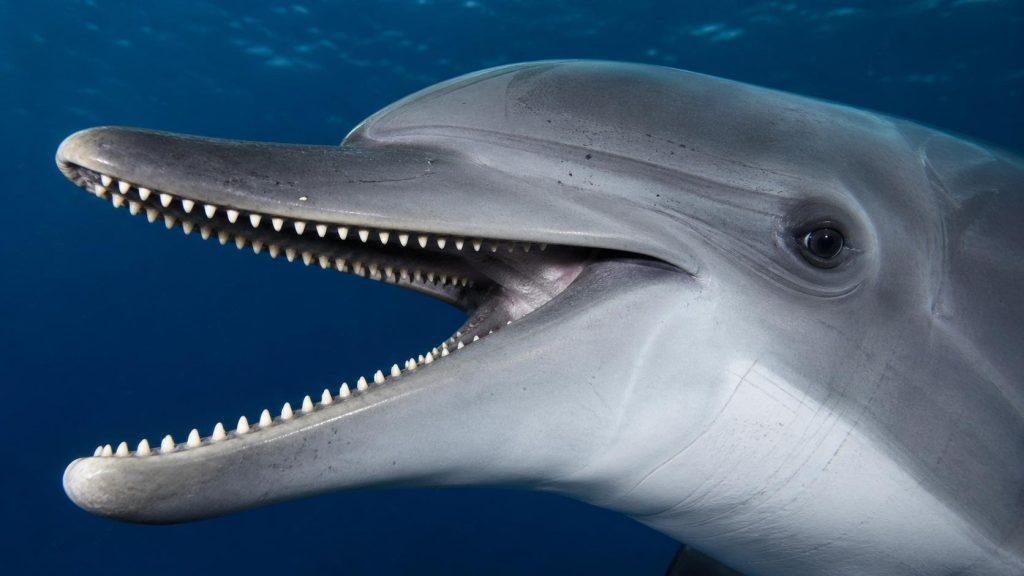
Humans have four distinct types of teeth. Incisors cut, canines tear, premolars and molars grind. That mix of different shapes is called heterodont dentition, and most land mammals share it. Dolphins are built entirely differently. Every tooth in a dolphin’s mouth is the same conical shape, pointed and smooth, from front to back on both jaws. Biologists call this homodont dentition, and it is found in nearly every dolphin species on the planet.
The reason comes down to feeding strategy. Dolphins do not chew their food. There is no need for grinding molars or slicing incisors when the entire approach is to catch prey and swallow it whole. Every tooth in a dolphin’s jaw serves a single purpose: gripping slippery, fast-moving animals long enough to get them down the throat. That simplified design has proven extraordinarily effective for tens of millions of years.
How Many Teeth Does a Spinner Dolphin Have?
The spinner dolphins found off Oahu’s Waianae Coast are among the most tooth-rich dolphin species in the ocean. A spinner dolphin typically has between 45 and 65 teeth along each side of its upper and lower jaw. When you count all four rows together, a single spinner dolphin can carry close to 200 to 250 teeth in its mouth at one time.
For comparison, a Risso’s dolphin, a species occasionally spotted in Hawaiian waters, may have fewer than 20 teeth in total. A bottlenose dolphin falls somewhere in between, usually around 72 to 104 teeth. Spinner dolphins sit at the high end of the count because their diet demands it. They feed on small fish, squid, and shrimp, often hunting in the open ocean at night, and those thin, tightly packed rows of teeth are built to snag prey that would otherwise escape in the dark. Tooth shape and count vary by species and diet:
- Spinner dolphin teeth are thin, sharp, and slightly curved for catching small, agile fish
- Bottlenose dolphin teeth are thicker and more cone-shaped to handle larger prey
- Risso’s dolphins have few or no upper teeth because they feed primarily on squid using suction
One Set for Life
Here is the detail that surprises most people: dolphins grow only one set of teeth for their entire lives. Sharks cycle through thousands of teeth over a lifetime, constantly replacing old ones with new ones. Dolphins cannot do that. The teeth a spinner dolphin grows early in life are the only ones it will ever have, and they have to last 20 years or more.
This makes tooth health critically linked to survival. A dolphin with worn or damaged teeth has a harder time catching prey. In older wild dolphins, researchers have documented significant wear along the tooth tips, a record of years spent grabbing rough-scaled fish and struggling squid. Because there is no backup set coming in, the condition of a dolphin’s teeth reflects the full history of its feeding life.
Reading Age from a Dolphin’s Tooth
One of the most useful things about dolphin teeth is what they reveal to scientists. Like the growth rings inside a tree trunk, the internal structure of a dolphin’s tooth records time in annual layers. Each year, a thin band called a dentinal growth layer forms inside the tooth’s core. Researchers can slice a tooth thinly, stain it, and count those layers under a microscope to estimate how old the dolphin was when the tooth was collected.
This method has been used to study Hawaiian spinner dolphin populations for decades. It gives scientists a way to understand the age structure of a pod, track how long individuals live, and assess the health of the population over time. Spinner dolphins in Hawaiian waters have been documented living 20 years or longer, and the evidence for that lifespan sits inside the growth rings of their teeth.
What You Are Really Seeing When Dolphins Smile
From the deck of a boat off the Waianae Coast, you will not be counting teeth. But knowing they are there changes what you see. When a spinner dolphin surfaces and opens its mouth, or when a calf mimics feeding behavior alongside its mother, you are watching a precision hunting tool in action. Those rows of conical teeth are what allow this species to hunt in near-total darkness hundreds of feet below the surface and still come back up with food.
At Dolphins and You, our tours depart from Waianae Boat Harbor each morning at 8:00 AM and again at noon, with complimentary transportation from Waikiki hotels and Ko Olina. You will spend three hours on the water with wild spinner dolphins in their natural habitat. Snorkel gear, a fresh lunch, a waterslide, kayaking, stand-up paddleboarding, and a live hula performance are all part of the experience. Rated 4.9 stars by more than 2,900 guests.
A Jaw-Dropping Design for Life in the Sea
Dolphin teeth are not decorative. They are a precision hunting instrument that has barely changed in millions of years because it works. One shape, one set, up to 250 teeth, zero chewing. From the earliest days of life to the last, those same conical rows are how a spinner dolphin makes its living in the open Pacific. And off the Waianae Coast of Oahu, one of the largest spinner dolphin populations in the main Hawaiian Islands puts that design to work every single day.
Want to explore more about spinner dolphin biology and anatomy?
👉Return to the Spinner Dolphin Anatomy and Biology guide →
Tours depart from Waianae Boat Harbor, West Oahu, where Hawaii’s spinner dolphins gather every morning.