


Spinner Dolphin Courtship in Hawaii: What Really Happens When Dolphins Fall for Each Other
When a spinner dolphin pod starts moving differently off the Waianae coast, it is usually noticeable from the boat. The group gets tighter. Two animals begin swimming in close parallel, nearly touching. One rolls slowly toward the other. What looks like casual play is often something else entirely. Understanding what is actually happening in those moments makes the water a far more interesting place.
A Society Built for Meeting New Partners
Spinner dolphins in Hawaii do not live in fixed, closed groups. They live in what scientists call a fission-fusion society, which means the makeup of any given pod changes constantly depending on what the animals need at a given time. A pod resting inshore in the morning may number in the dozens or the hundreds. By evening, those same animals may have split into smaller feeding groups and rejoined with dolphins from entirely different daytime pods. This fluid social structure is central to how spinner dolphins find and select mates. Individuals are not locked into the same small circle of companions year after year. Over the course of their lives, they have regular contact with a wide range of potential partners drawn from across the larger regional population. The ocean is not a small world for these animals. It is an open social network.
What Courtship Actually Looks Like
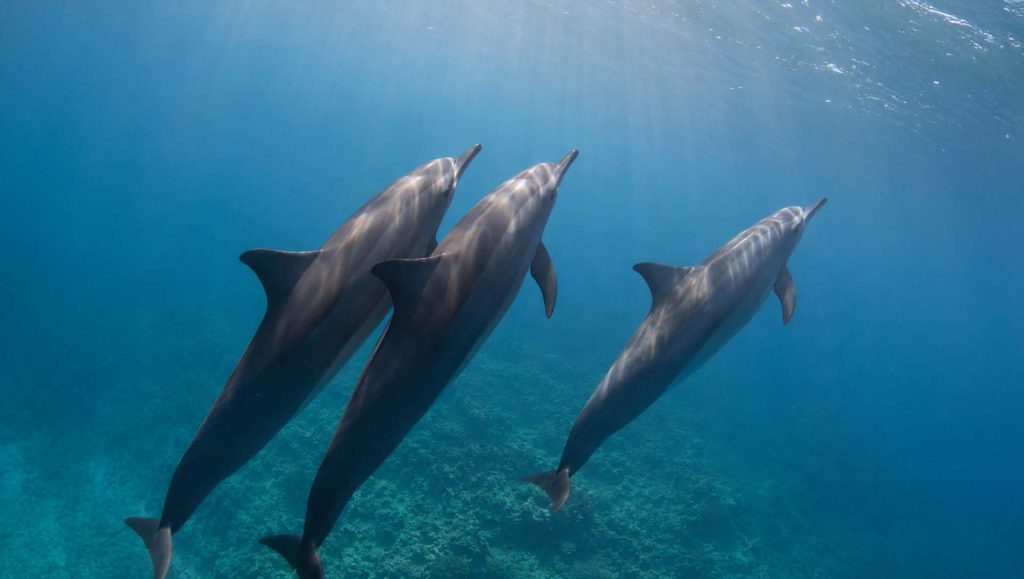
Spinner dolphin courtship does not follow a single rigid script, but there are recognizable behaviors that researchers have documented across multiple populations. A male pursuing a receptive female will typically swim alongside her in close parallel, matching her speed and direction with unusual precision. Flipper-to-flipper contact is common, as is gentle rubbing along the flanks and belly. At the surface, courting pairs sometimes perform slow belly-to-belly rolls, turning toward each other and then upright again in a synchronized movement that is clearly intentional rather than accidental.
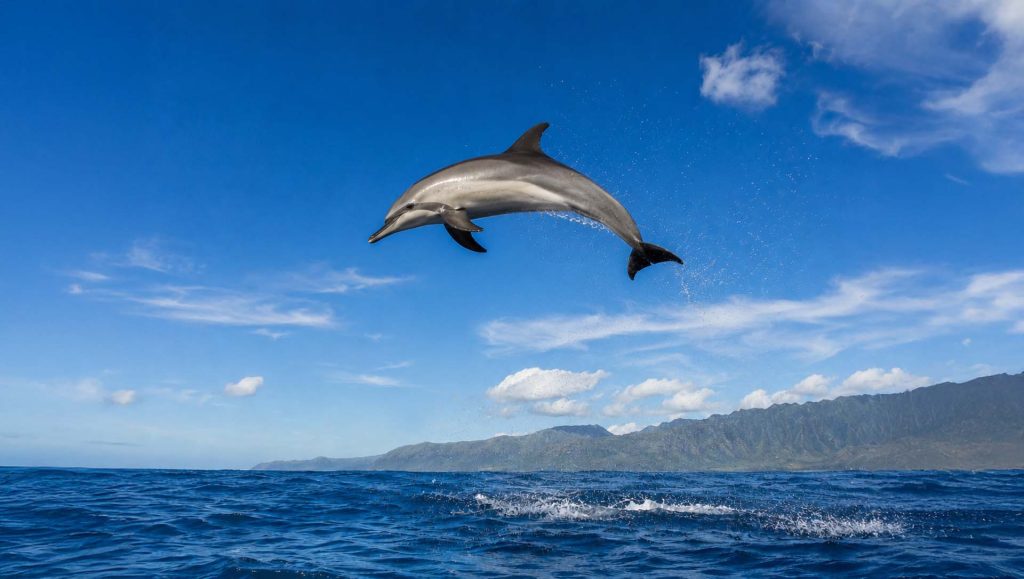
Vocalizations increase during courtship. The standard clicks and whistles dolphins use during travel give way to more varied, repetitive exchanges between individuals that scientists associate with close social bonding and heightened arousal. Males also tend to increase their aerial behavior when actively courting. The spinning leaps that give spinner dolphins their name are not purely for long-distance communication or group coordination. They may also serve as displays of physical fitness, with height, rotation count, and controlled landing creating a visible signal of a male’s condition and energy to females watching nearby.
How Males Compete
Spinner dolphin males compete for access to receptive females, but they do it differently than some better-known marine mammals. There are no head-on charges, no serious bite wounds from rivals, no organized male coalitions blocking a female’s path. The competition plays out through persistence and positioning. A male attempting to court a female in a large pod is also navigating other males attempting the same thing, which creates something closer to a crowd than a confrontation: multiple males swimming near the same female, each trying to maintain the closest position and occasionally displacing a rival by simply outmaneuvering him for proximity. It is subtle, but it is real competition, and the female at the center of it has full awareness of what is happening around her.
Female Choice and the Absence of Pair Bonds
Females in spinner dolphin populations are not passive in the mating process. A spinner dolphin female can and does reject advances by swimming faster, seeking the center of the larger group, or changing direction persistently enough that a male gives up. Research on dolphin mate choice has consistently shown that females exercise real agency in selecting partners, and there is no reason to think Hawaiian spinner dolphins behave differently.
Spinner dolphins are promiscuous in the biological sense. Both males and females typically mate with more than one partner, and neither sex forms lasting pair bonds. After mating, the male does not remain with the female through pregnancy or calf-raising. The female carries the calf, gives birth without the male’s involvement, and raises her young within the pod community. Other adult females in the pod, particularly those not currently nursing their own calves, often assist with calf care in a behavior researchers call alloparenting. This communal approach to raising young is one reason spinner dolphin calves have relatively solid survival rates despite the absence of an involved father.
The Timeline From Courtship to Calf
Female spinner dolphins reach sexual maturity somewhere between five and seven years of age. Males take longer, typically maturing between seven and ten years. Once mature, females give birth roughly every two to three years, depending on the survival of the current calf and environmental conditions. Calves arrive in Hawaiian waters throughout the year, though there are seasonal peaks. Like all cetaceans, spinner dolphin calves are born tail-first and surface immediately to take their first breath. They are nursing within hours of birth and will continue receiving milk for one to two years, sometimes longer, while also learning to catch fish alongside the adults in the pod.
Gestation lasts roughly ten and a half months, which means a female who mates in one spring may give birth the following spring. That calf will then spend years learning the routes, social relationships, and hunting patterns of the same pod that watched it arrive in the world.
Watch: Spinner Dolphins in Their Natural World
This full documentary on spinner dolphin behavior captures the daily rhythms of wild pods, including the social interactions that shape how these animals live, move, and connect with each other.
What You Might Notice on the Water
The behavioral cues for courtship are subtle enough that casual observers often miss them, but once you know what to look for, they are hard to unsee. A pair of dolphins swimming in unusually tight parallel, matching each other’s every turn more closely than the rest of the pod, is worth watching. A slow surface roll where one animal turns belly-up toward another and then rights itself again is almost always social rather than a feeding or comfort movement. Increased leaping from a single male near a specific female is another sign worth noting.
None of these behaviors are rare. On any given morning on the water, somewhere in the pod, something like this is happening. The NOAA-compliant ethical guidelines we follow on the Dolphins, and You tour give wild pods the space they need for natural behavior, which means you are watching an undisturbed population doing what spinner dolphins actually do, not a group performing for the boat.
The Dolphins and You tour departs from Waianae Boat Harbor at 8:00 AM and noon daily. The three-hour excursion includes snorkel gear, kayaks, paddleboards, a water slide, and a fresh sandwich lunch.
More Than a Show
What spinner dolphins do when they leap, chase, roll, and call is not performance. It is the full business of being alive: choosing partners, building alliances, raising young, and staying connected inside a society that has been working itself out in the Pacific for millions of years. The next time a dolphin surfaces near your boat and you find yourself wondering what it is thinking, the honest answer is that it probably has quite a lot on its mind.
👉Join us on the water and watch it unfold in real time.

Want to explore more about how Hawaii’s spinner dolphins think and behave?
👉Return to the Dolphin Behavior and Intelligence guide →
Tours depart from Waianae Boat Harbor, West Oahu, where Hawaii’s spinner dolphins gather every morning.