



Warm-Blooded in Cold Water: How Dolphins Regulate Their Body Temperature
Being a mammal in the ocean is not a simple thing. Dolphins are warm-blooded, just like humans, and they need to maintain an internal body temperature somewhere between 97 and 100 degrees Fahrenheit at all times. Drop too far below that and their organs begin to fail. Rise too far above it and they overheat. The challenge is that ocean water, even in tropical Hawaii, is consistently cooler than a dolphin’s core body temperature, and it pulls heat away from the body far faster than air ever could. Water conducts heat roughly 25 times more efficiently than air, meaning a dolphin in the ocean is always working against the pull of its environment.
That challenge is not something the dolphin struggles with every day. It is a problem the dolphin was born already having solved. The thermoregulation system built into a dolphin’s body is one of the most carefully engineered biological adaptations in the sea.
The Foundation: Blubber
Ask most people how a dolphin stays warm, and they will mention blubber. That answer is correct, but the details make it far more interesting than it first sounds.
Blubber is a dense layer of adipose tissue, a specialized form of fat, found just beneath a dolphin’s skin and above its muscle layer. Unlike the body fat found in land mammals, blubber in a marine animal is tightly structured and has a very low thermal conductivity, meaning it is remarkably poor at allowing heat to pass through it. Heat generated by the dolphin’s muscles and organs stays inside the body rather than bleeding outward through the skin and into the surrounding water.
The thickness of a dolphin’s blubber layer varies by species, region of the body, and individual condition. Hawaii’s spinner dolphins carry a thinner blubber layer than arctic species because the Pacific waters around Oahu are significantly warmer than polar seas. But that layer is still essential. Even in water that feels comfortable to a human swimmer, a dolphin without adequate blubber would struggle to maintain its internal temperature during long periods of low activity, such as the resting periods spinner dolphins spend near the coast each morning.
Blubber also functions as an energy reserve. When food becomes scarce, a dolphin can metabolize its own blubber for fuel. This dual role, insulation and long-term energy storage, makes it one of the most efficient biological materials found anywhere in the animal kingdom.
The Clever Plumbing: Countercurrent Heat Exchange
Blubber protects the dolphin’s core, but it creates a secondary challenge. The flippers, flukes, and dorsal fin are thin and cannot hold much of it. They need to be flexible and hydrodynamic to function at all, which means they are relatively exposed to the cooler surrounding water. If blood flowing from the heart through those thin appendages returned to the core having lost most of its warmth, the dolphin would gradually chill from within, even with a thick blubber layer protecting everything else.
Evolution solved this problem with a system called countercurrent heat exchange, and it is one of the most elegant pieces of circulatory engineering in the natural world.
Inside the flippers and flukes, the arteries carrying warm blood away from the heart run directly alongside the veins carrying blood back toward it. The blood flows in opposite directions through these adjacent vessels, warm arterial blood moving outward while cool venous blood moves inward toward the core. As the warm blood flows toward the flipper tip, it transfers heat across the thin vessel walls into the returning cold blood, warming it before it reaches the heart. By the time the arterial blood arrives at the outermost part of the flipper, it has already shed much of its heat. By the time the venous blood returns to the core, it has been substantially rewarmed rather than arriving cold and pulling down the dolphin’s core temperature.
The result is a stable thermal gradient where the core stays consistently warm and the extremities run cooler, without cutting off circulation to the fins. The system works so efficiently that engineers have studied it as a model for managing heat in industrial and mechanical systems.
Staying Cool in Hawaii’s Warm Waters
Thermoregulation is not only about staying warm. In Hawaii’s tropical Pacific waters, spinner dolphins face the opposite challenge during and after high-speed activity. When a dolphin sprints, its muscles generate enormous amounts of heat. Without a way to release that heat, internal temperatures could climb to dangerous levels during a long nighttime hunting run.
The same blood vessel network that conserves heat during rest can operate in reverse during exertion. When a spinner dolphin needs to shed heat, blood flow to the surface of the skin increases through a process called vasodilation, allowing heat to radiate outward into the surrounding water. The ocean, which at rest functions as a heat drain to resist, becomes a useful cooling surface during activity.
This ability to switch modes, from conserving heat to releasing it, is what makes dolphins genuinely suited to the ocean rather than simply tolerant of it. The same body that holds warmth during long morning rest sessions near the Waianae Coast can manage the thermal load of an entire night of deep-water hunting without overheating.
The Role of Skin Color
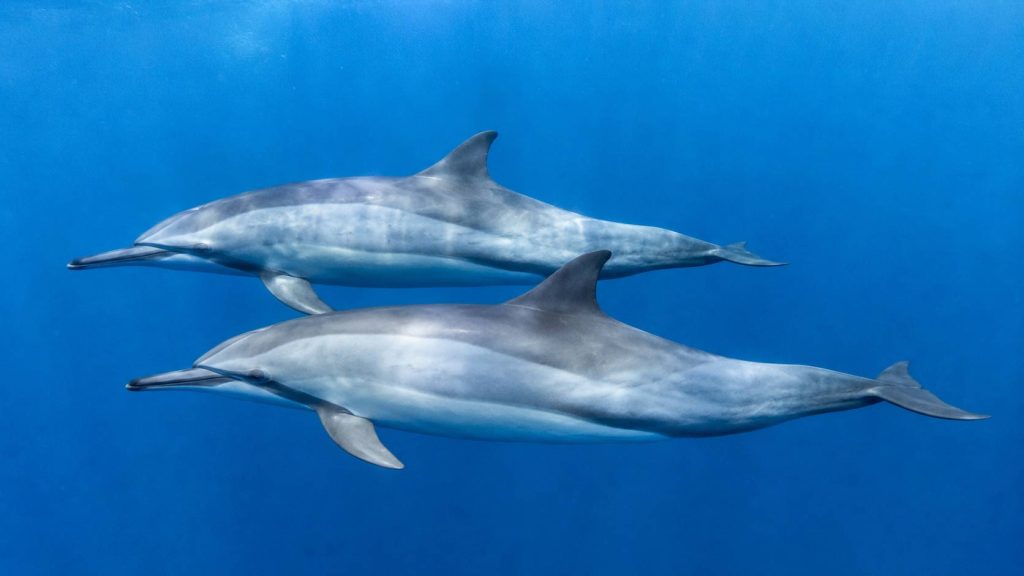
One detail of dolphin thermoregulation that rarely gets attention is skin color. Hawaii’s spinner dolphins, like most dolphin species, have a dark upper surface and a lighter underside, a pattern called countershading. While this arrangement is often discussed as camouflage, the dark dorsal coloring also absorbs solar radiation when a dolphin is at the surface. Spinner dolphins resting near the coast in the morning sunlight are passively absorbing warmth through their skin. It is a small contribution compared to the blubber and circulatory systems, but in a warm tropical environment where maintaining precise thermal balance matters, every mechanism has a role.
Calves and the Challenge of Less Blubber
Young spinner dolphins are born with significantly thinner blubber than adults, making thermoregulation more demanding in the early months of life. This is one reason calves stay closely positioned to their mothers. A calf swimming in a mother’s slipstream expends less energy on forward movement, which leaves more energy available for generating internal warmth. Mothers also nurse calves on fat-rich milk that helps build the blubber layer quickly.
In Hawaii’s warm coastal waters near the Waianae Coast, the lower blubber burden is less dangerous to a young calf than it would be in colder seas. The shallow, sunlit water where spinner dolphin pods rest after nighttime feeding is a functional part of the young dolphin’s thermal environment, not just a convenient resting spot.

What You See From the Boat
When you and the Dolphins tour heads out along the Waianae Coast each morning, the spinner dolphins you encounter have typically spent the night hunting in deeper, cooler offshore waters. By morning, they return inshore to rest, socialize, and recover. The warm sunlit shallows near the coast are not just comfortable. For calves and older individuals carrying thinner blubber, that shallow, sun-warmed environment is a meaningful part of their daily thermal management.
A pod resting at the surface in the morning light, dorsal fins lifting gently, some animals logging along on their sides, others moving slowly through the group, is a pod in thermoregulatory balance. The sun on their backs, the warm shallow water, the reduced exertion of rest rather than a sprint, all of it is the dolphin’s system working exactly as it was designed to work.
The Dolphins and You tour includes everything you need to spend the morning with them.
- Round-trip transportation from Waikiki or Ko Olina
- Snorkel gear including mask, fins, and life vest
- Sandwich lunch with chips and a beverage
- Live hula performance onboard
- Access to the 12-foot water slide, kayaking, and stand-up paddleboarding
Tours depart daily at 8:00 AM and 12:00 PM, with the full experience running about three hours on the open water.
A System Running Quietly Every Minute
Every second a spinner dolphin is alive, its thermoregulation system is making small adjustments. Blood moving toward the skin during a sprint to shed heat. Blood redirected away from the extremities during a cool morning rest to protect core warmth. The blubber layer holding steady against the constant pull of the surrounding ocean. The countercurrent network in the flippers quietly recycling heat from outgoing blood to returning blood without any effort from the animal.
This system has no dramatic visible component. You cannot see it working from a boat or from the water. But knowing it is there changes how you understand the pod you are watching. Every spinner dolphin along the Waianae Coast is a warm-blooded mammal maintaining precise thermal balance in one of the most physically demanding environments a mammal can live in, and doing it without any visible effort at all.
Built for the Ocean, Down to the Temperature
Dolphins did not stumble into the sea and adapt just enough to get by. They are built for it, with the kind of precision that comes from tens of millions of years of refinement. Their blubber insulates. Their countercurrent circulatory system recycles warmth. Their skin absorbs solar heat when they need it. And when activity drives their temperature up, the entire system reverses and the ocean becomes the solution.
The morning pod you see from the bow of the Dolphins and You boat is not just surviving in the Pacific. It is exactly where its biology was always designed to be.
Want to explore more about how spinner dolphins are built for life in the ocean?
👉Return to the Spinner Dolphin Anatomy and Biology guide →
Tours depart from Waianae Boat Harbor, West Oahu, where Hawaii’s spinner dolphins gather every morning.