


More Than a Cute Face: The Dolphin Forehead That Thinks in Sound
When you watch a spinner dolphin glide past the boat on the Waianae Coast, the first thing you notice is that smooth, rounded forehead. It looks almost geometric, like the front of a submarine. Most people assume it is just the shape of the skull. It is not. That bulge is called the melon, and it is one of the most sophisticated biological instruments in the animal kingdom. Understanding what it does changes the way you see every dolphin you will ever look at.
What the Melon Actually Is
The melon is not bone and it is not muscle. It is a fatty organ, a dense, carefully structured mass of specialized lipids located directly in front of the dolphin’s blowhole. Those fats are chemically unlike the fat found anywhere else in the dolphin’s body. They are arranged in layered gradients, each layer with a slightly different density, and that arrangement is what gives the melon its power. The whole structure behaves like a biological acoustic lens, gathering sound from behind it and shaping it into a forward-facing beam with remarkable precision.
Researchers have studied the lipid composition of the melon for decades and continue to find that its acoustic properties are extraordinarily fine-tuned. The densities and arrangements vary from species to species, which is part of why different dolphins have different forehead shapes. The spinner dolphins you see off Oahu’s Waianae Coast have a melon that is perfectly matched to the kind of open-water, deep-diving sonar work they need to do.
Where Sound Actually Comes From
Most people assume dolphins make sound through their blowholes, the same way a person whistles through their lips. That is not quite right. The sound that powers echolocation is produced by structures called phonic lips, vibrating tissue located along the nasal passage just inside the dolphin’s head, beneath and behind the blowhole. When a dolphin pushes air through those structures, they vibrate and generate rapid clicks. The clicks are not exhaled into the water. They travel inward and upward, into the melon.
The blowhole itself is simply for breathing. The sound-making system and the breathing system share the same general airway, but they operate independently. Dolphins can produce echolocation clicks without exhaling any air at all, which is why they can use sonar while submerged without losing their breath supply.
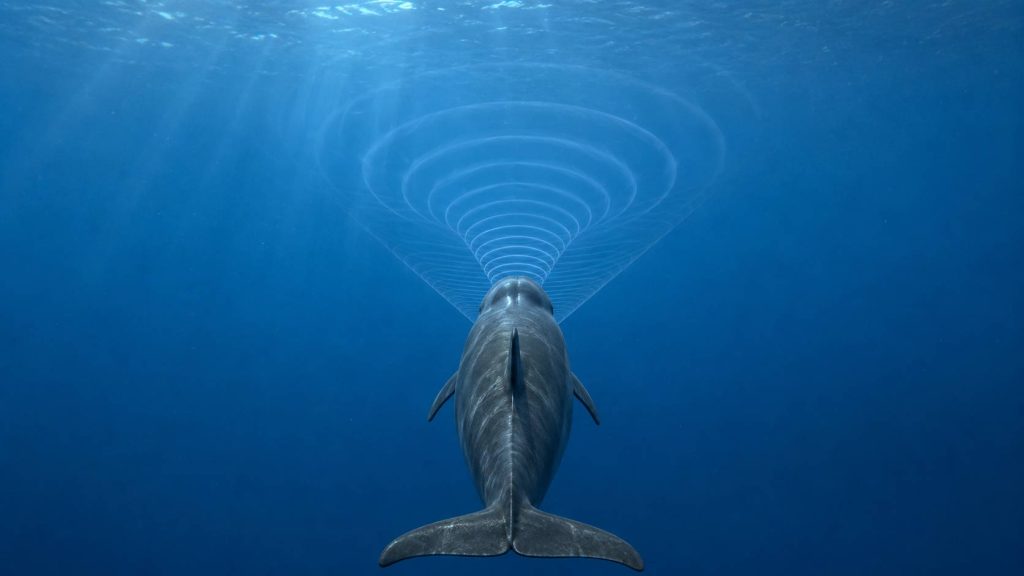
How the Melon Focuses Sound into a Beam
Once the phonic lips generate a click, the melon takes it and does something remarkable. Because the layers of fat inside the melon have different acoustic densities, the click is bent and refracted as it passes through, in the same way light bends when it passes through a glass lens. The result is a tightly focused, forward-pointing cone of sound that exits the front of the dolphin’s head like a beam.
What makes this even more impressive is that the dolphin can steer the beam. Muscles connect to the melon and can change its shape and stiffness on the fly. By adjusting the melon’s geometry, the dolphin can redirect the sonar cone without turning its head. A dolphin can be looking sideways and still ping an object directly in front of it. That level of control is something no human sonar system can fully replicate at that size.
Reading the Echo Through the Jaw
When the sound beam hits an object and bounces back, the returning echo does not re-enter through the melon. Instead, it enters through the lower jaw. A dolphin’s lower jaw is not solid bone. It is thin, hollowed out, and filled with channels of specialized acoustic fat called mandibular fat bodies. These fat channels conduct incoming sound directly to the inner ear, bypassing the outer ear entirely. The inner ear then sends the signals to the brain, which assembles them into a detailed acoustic image of whatever the dolphin pinged.
The brain processes these images so quickly and accurately that dolphins experience their environment through echolocation the way humans experience it through vision. They perceive shape, texture, density, distance, and movement simultaneously. A dolphin inspecting you with its sonar is receiving a three-dimensional picture that includes the air spaces inside your lungs, the density of your bones, and the movement of your heartbeat.
What Dolphins Can Actually Detect
The precision of dolphin echolocation is difficult to fully appreciate until you look at the numbers. Bottlenose dolphins, closely related to spinner dolphins, have been documented detecting an object the size of a ping-pong ball from roughly the length of a football field away. They generate clicks at frequencies up to 150 kilohertz, which is more than seven times above the upper limit of human hearing. The range and resolution of what they can perceive acoustically is far beyond what our own sensory systems can process.
In practical terms, this means dolphins can detect fish hiding under sand, distinguish between species of fish based on the density of their swim bladders, sense the shape and speed of objects behind them, and navigate at night in total darkness with the same ease they navigate in daylight. The melon is why all of that is possible.
- Detection range: objects detectable from a football field away or more
- Click frequency: up to 150 kilohertz, well beyond human hearing
- Returns received: through acoustic fat channels in the lower jaw
- Brain processing: assembles 3D acoustic images in real time
Always On, Always Working
A dolphin’s melon is not something they switch on when they need it. It is active continuously during waking hours, building a constant picture of everything around them. When the Dolphins and You vessel approaches a pod of spinner dolphins on the Waianae Coast, those dolphins have been acoustically scanning the boat, the engine, and the passengers for several minutes before anyone on deck spots them. They already know the shape of the hull, how many people are aboard, and whether there are any snorkelers preparing to enter the water.

This is also why spinner dolphins can travel in tight pods of dozens of animals moving at speed without any collisions. Each individual is continuously sharing its sonic picture with the group, adjusting course in real time based on the information flooding in through their melons and jaws. What looks like a graceful, effortless formation from the deck of a boat is actually an extraordinary feat of coordinated acoustic processing happening faster than any computer network humans have built.
Technology That Followed the Dolphin
Engineers and military researchers began studying dolphin echolocation in the twentieth century and have been trying to replicate it ever since. Modern sonar systems, underwater mapping technology, and medical ultrasound imaging are all rooted in the same principle the dolphin figured out millions of years ago: focused, high-frequency sound can reveal what light cannot. The melon’s lipid gradient design has been studied as a model for acoustic lens engineering. The mandibular fat body pathway has influenced how researchers think about underwater microphone placement.
After decades of research, dolphin sonar still outperforms any equivalent human-built system in terms of size, precision, and energy efficiency. The melon remains one of the most elegant solutions to a hard problem that evolution has ever produced. Odontocetes, the group that includes all toothed whales and dolphins, have carried this technology for roughly 34 million years.
What You Are Seeing on the Water
The next time you watch a spinner dolphin rise toward the surface off Oahu’s Waianae Coast, take a moment to look at that smooth, rounded forehead as it catches the morning light. Under Hawaii’s waters, the Marine Mammal Protection Act ensures that these animals are observed from a safe and respectful distance, which means the spinners you see are relaxed, resting, and moving freely. Many of them will already be aware of you long before the boat arrives, their melons quietly building a picture of the vessel, the passengers, and the water between you.
That rounded forehead is not decoration. It is a precision instrument refined over tens of millions of years of evolution, and it is one of the reasons spinner dolphins are among the most capable hunters, communicators, and navigators on the planet.
When You See the Forehead, Remember What’s Inside It
Every spinner dolphin you encounter on the Waianae Coast is carrying one of nature’s greatest engineering achievements on the front of its face. The melon is proof that the ocean solved problems of detection, navigation, and communication long before humans invented the tools to do the same. If you have ever wondered why dolphins seem so effortlessly aware of everything happening around them, now you know. They are listening to the world with a forehead full of living sound.
Want to explore more about how spinner dolphins sense and navigate their world?
👉Return to the Spinner Dolphin Anatomy and Biology guide →
Tours depart from Waianae Boat Harbor, West Oahu, where Hawaii’s spinner dolphins gather every morning.